American kitchens are becoming warmer, more functional and more closely connected to everyday life.
Consumers still care about how a kitchen looks, but appearance is increasingly tied to how well the space works. Cabinets are expected to organize food, cookware, appliances and household routines while also helping the kitchen feel comfortable and visually connected to the rest of the home.
That shift is creating renewed interest in wood kitchen cabinets.
According to the 2026 U.S. Houzz Kitchen Trends Study, wood became the most popular cabinet color among homeowners renovating their kitchens, selected by 29% of respondents and moving slightly ahead of white at 28%. Cabinetry itself remains one of the most important parts of the renovation, with 84% of surveyed homeowners upgrading their cabinets.
For retailers, distributors, importers and cabinet companies, this creates more than a design opportunity. The product range has to translate changing consumer preferences into an assortment that is easy to understand, practical to stock and consistent enough to reorder.
SSR develops wood kitchen cabinets and RTA cabinet programs around this connection between market demand and repeatable B2B supply.
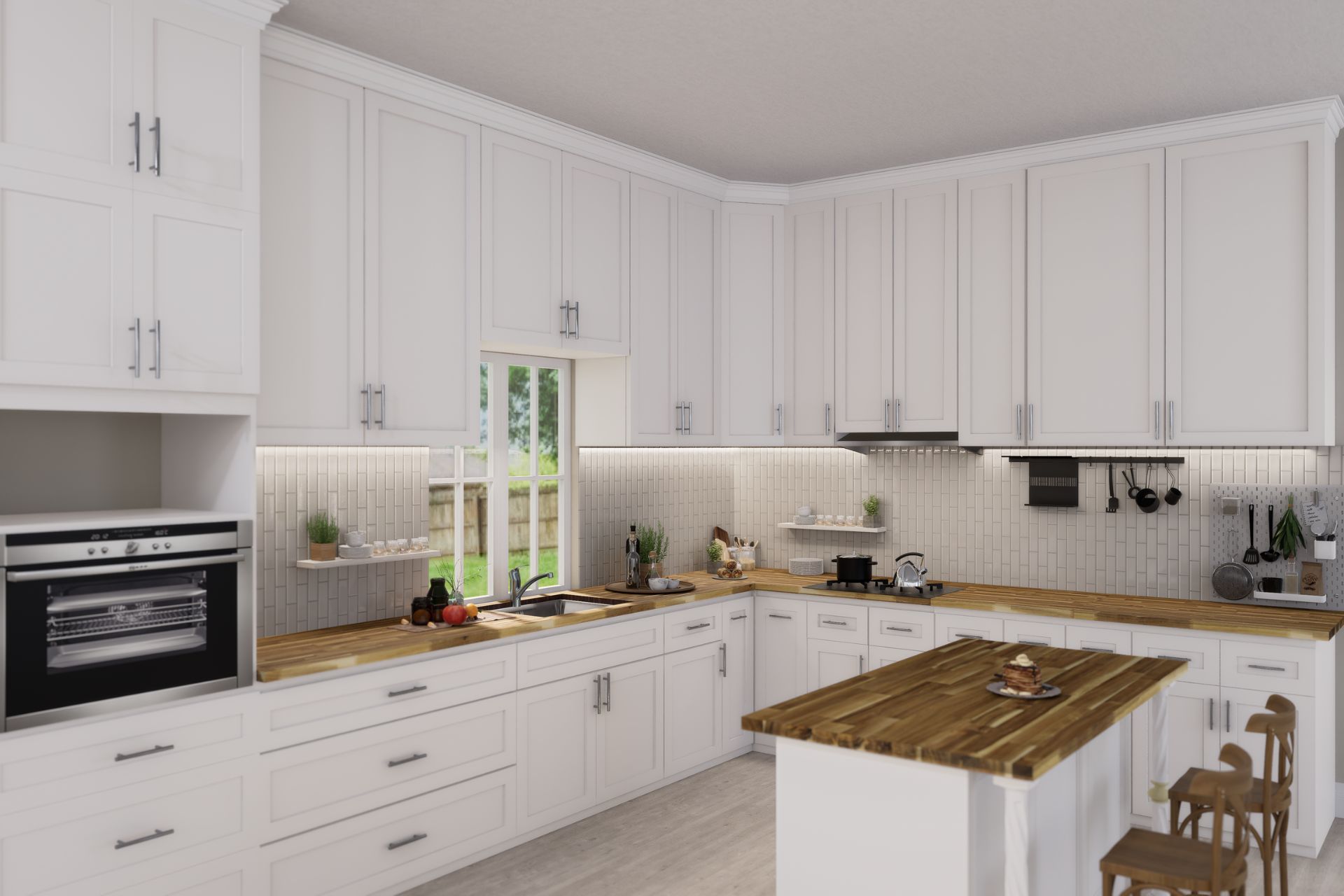
Natural wood cabinetry is bringing warmth back into U.S. kitchens while supporting increasingly functional living spaces.
Natural Wood Is Returning Without Bringing Back the Old Kitchen
The return of wood does not mean consumers want kitchens that look traditional or dated.
Current demand is moving toward cleaner surfaces, softer natural tones and visible grain that adds warmth without dominating the room.
Houzz reports that medium wood tones accounted for 15% of renovated kitchens in its 2026 study, followed by light wood at 11%. NKBA’s 2026 Kitchen Trends Report points in the same direction, with 59% of industry professionals surveyed identifying wood grain cabinetry as growing in popularity.
The change matters for product development.
A natural finish now needs to work comfortably alongside stone countertops, neutral walls, simple hardware and modern appliances. The cabinet may still show the character of real wood, but the overall kitchen is cleaner and more restrained.
Consumers are essentially looking for warmth without visual heaviness.
Retail assortments can respond by focusing on wood tones and door styles that work across several interior directions rather than building collections around highly specific trends.
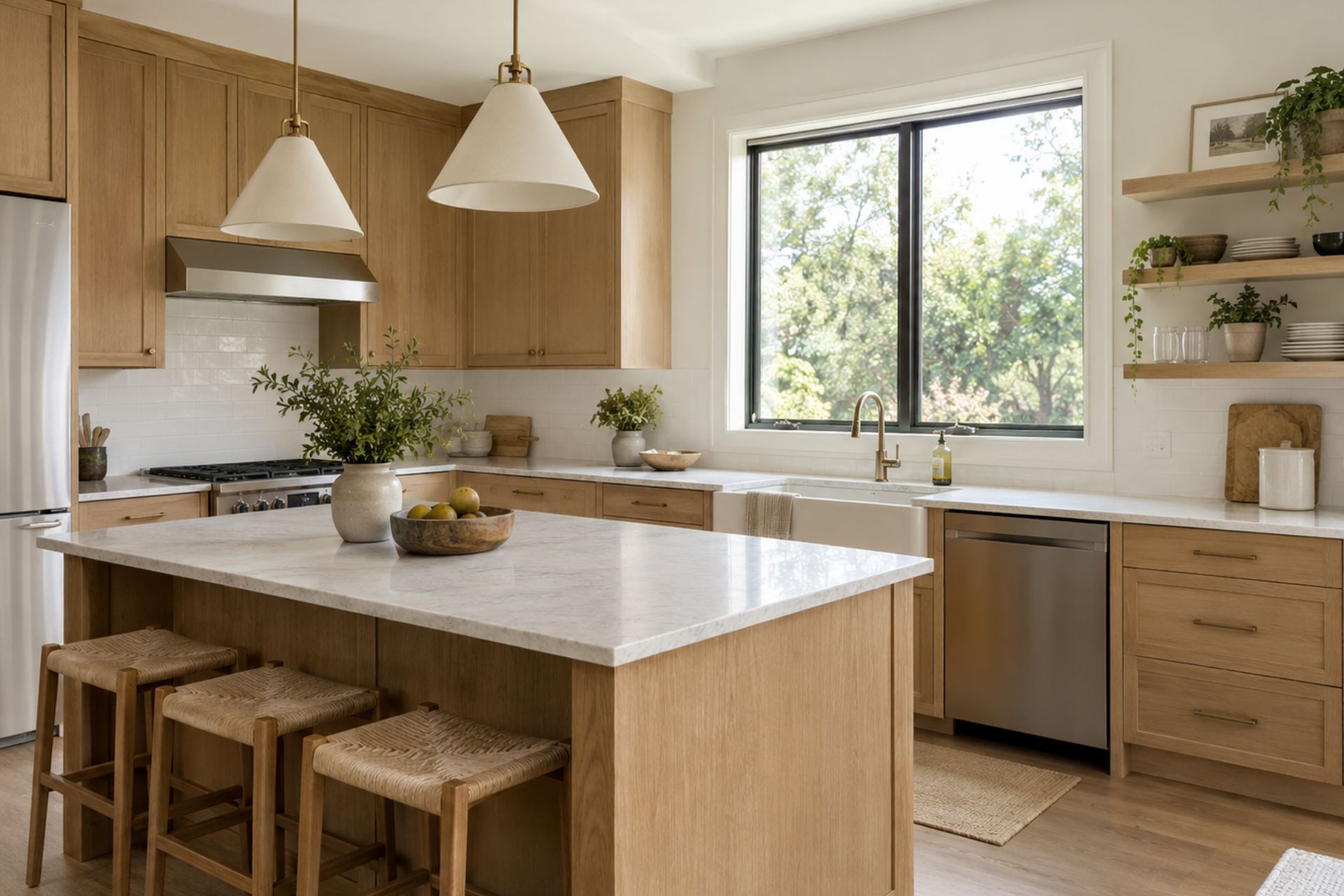
Medium and lighter wood tones can introduce natural character while keeping the kitchen visually clean and contemporary.
Storage Is Becoming Part of the Product, Not an Extra Feature
A cabinet is no longer evaluated only by its door style.
Consumers increasingly notice what happens when the door opens.
The 2026 Houzz study found that 76% of renovating homeowners added specialty built-in features. Pantry cabinets were included by 47%, while beverage stations appeared in 24% of projects. Cabinet upgrades overall remained close to universal at 84%.
NKBA also identifies floor-to-ceiling cabinetry, additional drawers, pantry spaces and storage-rich islands as important directions in upcoming kitchen design.
These numbers reflect a broader change in how Americans use the kitchen.
Coffee machines, countertop appliances, dry food, cookware and household supplies all compete for space. Consumers want more of those items accessible without leaving everything visible.
That creates demand for cabinet programs that extend beyond standard wall and base units.
Tall pantry cabinets can use vertical space more efficiently. Deep drawers improve access to cookware. Kitchen islands can combine storage with preparation and seating. Wall cabinets remain useful, but they increasingly work as one part of a more complete storage system.
SSR’s RTA wood kitchen cabinets range currently includes base, wall and tall cabinets, along with vanity units and complete set applications.
For retailers and distributors, the opportunity is therefore not simply to add more cabinet SKUs. The assortment should give consumers enough building blocks to create a kitchen that genuinely works better.
Timeless Design Makes an Assortment Easier to Carry Longer
Kitchen cabinetry has a long replacement cycle.
Consumers know they will probably live with the result for years, while retailers and distributors cannot rebuild an entire cabinet assortment every time a short-lived design trend appears.
That helps explain the continued strength of transitional and timeless design.
In NKBA’s 2026 research, 72% of respondents identified transitional or timeless kitchens as a leading style direction for the next three years. Contemporary, modern and minimalist interiors followed at 60%, while organic and natural design reached 58%.
This favors cabinet styles that can move between different interiors.
Shaker and recessed-panel doors can work in transitional homes without feeling overly decorative. Flat-panel fronts can serve cleaner contemporary kitchens. Raised-panel doors can remain relevant in more traditional segments without defining the entire product range.
SSR currently offers Shaker, Flat Panel, Raised Panel and Recessed Panel door directions within its RTA wood kitchen cabinets program.
The commercial advantage comes from choosing a focused range.
A retailer does not necessarily need dozens of fronts that compete with one another. A smaller group of recognizable styles, supported by carefully selected finishes, can cover more consumer preferences while making stocking and replenishment easier.
The Finish Has to Look Good Across an Entire Kitchen
Consumers rarely judge kitchen cabinetry one door at a time.
They see an entire wall.
Several wood kitchen cabinet fronts may sit next to one another, often under strong natural or artificial light. Grain direction, finish variation, door alignment and color consistency become much more noticeable when repeated across a full kitchen.
This is particularly important with natural wood kitchen cabinets.
Some variation is part of the material and often contributes to the appearance consumers want. Excessive inconsistency is different. If adjacent doors appear unrelated or finish quality changes visibly across the room, the consumer experiences it as a cabinet problem rather than a natural-material characteristic.
That distinction matters throughout the supply chain.
Samples may establish the design direction, but repeat production determines whether the program can maintain that direction across multiple orders.
Manufacturing control therefore has to consider the finished kitchen rather than only individual components.
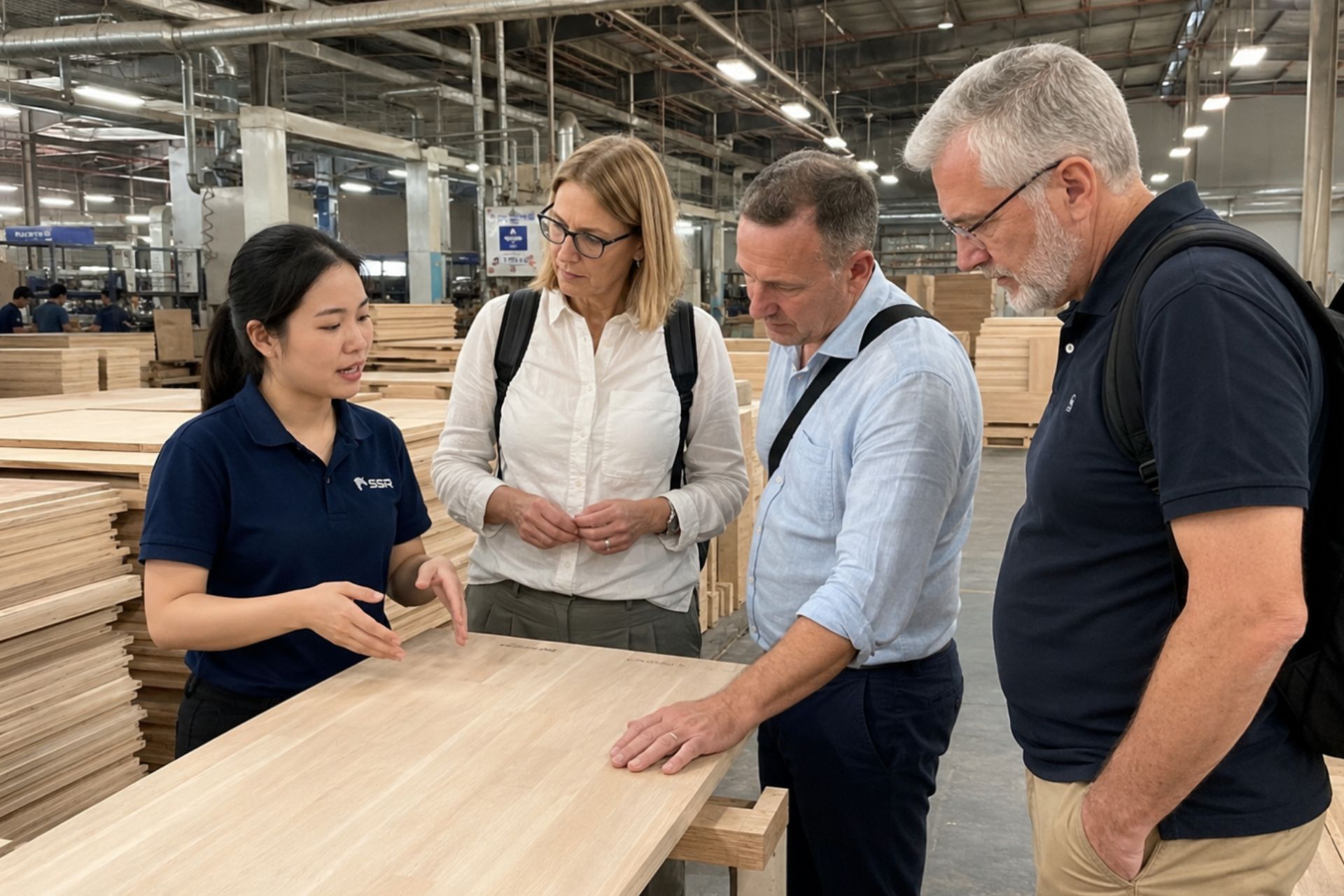
SSR supports cabinet production with material control, product development and manufacturing capabilities across a wider wood product platform, including cabinet components and solid wood panels.
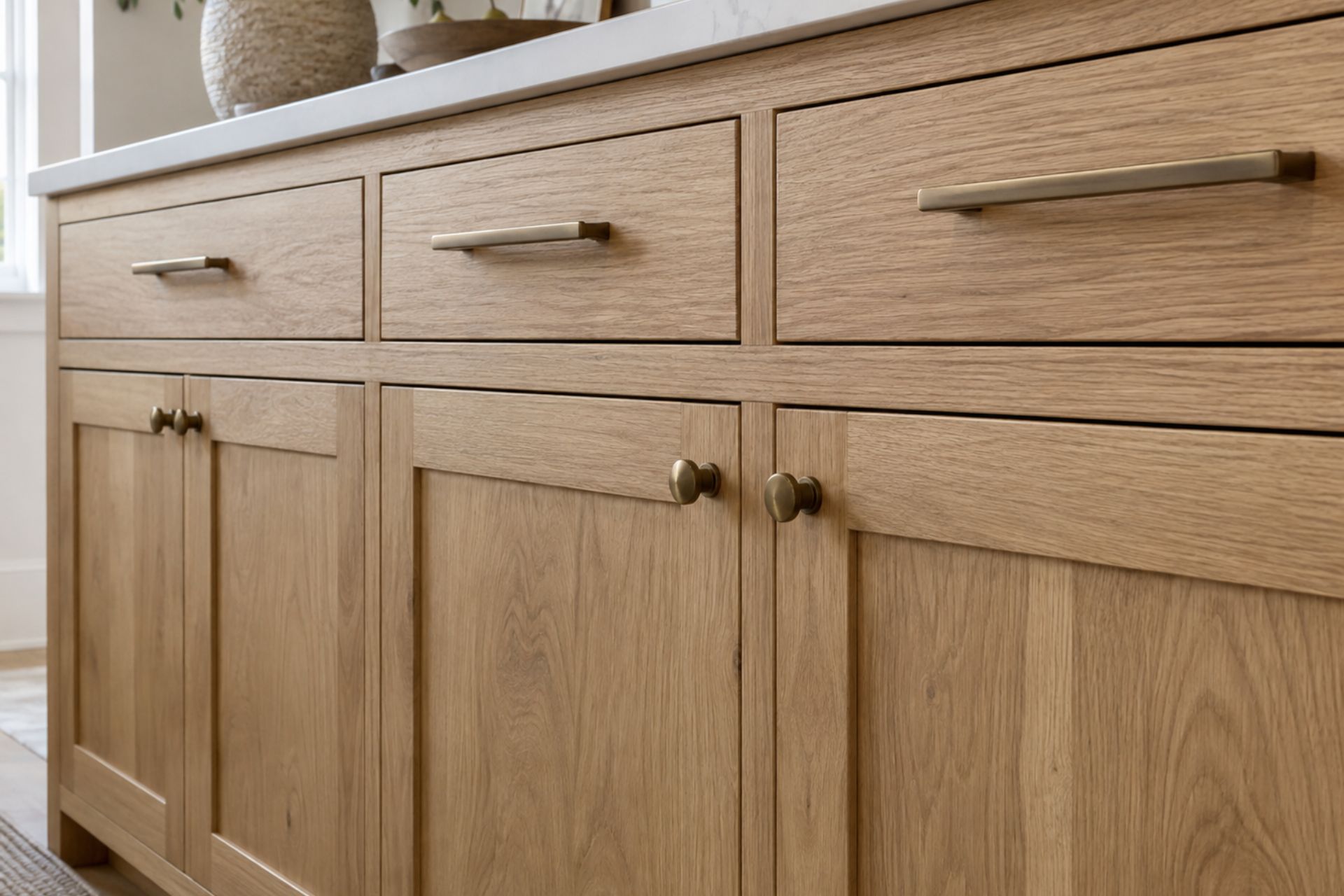
Consumers experience cabinetry as one continuous interior surface, making alignment and finish consistency important across the complete kitchen.
A Kitchen Has Become More Than a Cooking Space
One of the biggest changes in the U.S. market is happening around the kitchen itself.
It increasingly acts as part dining room, part storage system and part social space.
NKBA’s research found strong interest in lifestyle-oriented features such as dedicated beverage areas, identified by 85% of respondents, alongside eat-in kitchens and more personalized storage. The association also reports that kitchen design is becoming increasingly connected with the rest of the home.
Cabinetry makes much of this possible.
A tall wood kitchen cabinets can become a pantry. A dedicated group of units can create a coffee bar. An island can provide preparation space on one side and drawers or seating on another. Integrated panels can also make appliances less visually dominant.
This gives retailers an important merchandising opportunity.
Consumers often understand cabinetry better when they see how it changes daily life rather than when they see a technical drawing of a cabinet box.
Lifestyle imagery showing a pantry wall, kitchen island or breakfast area can communicate the value of an assortment much faster than a catalogue filled only with individual cabinet models.
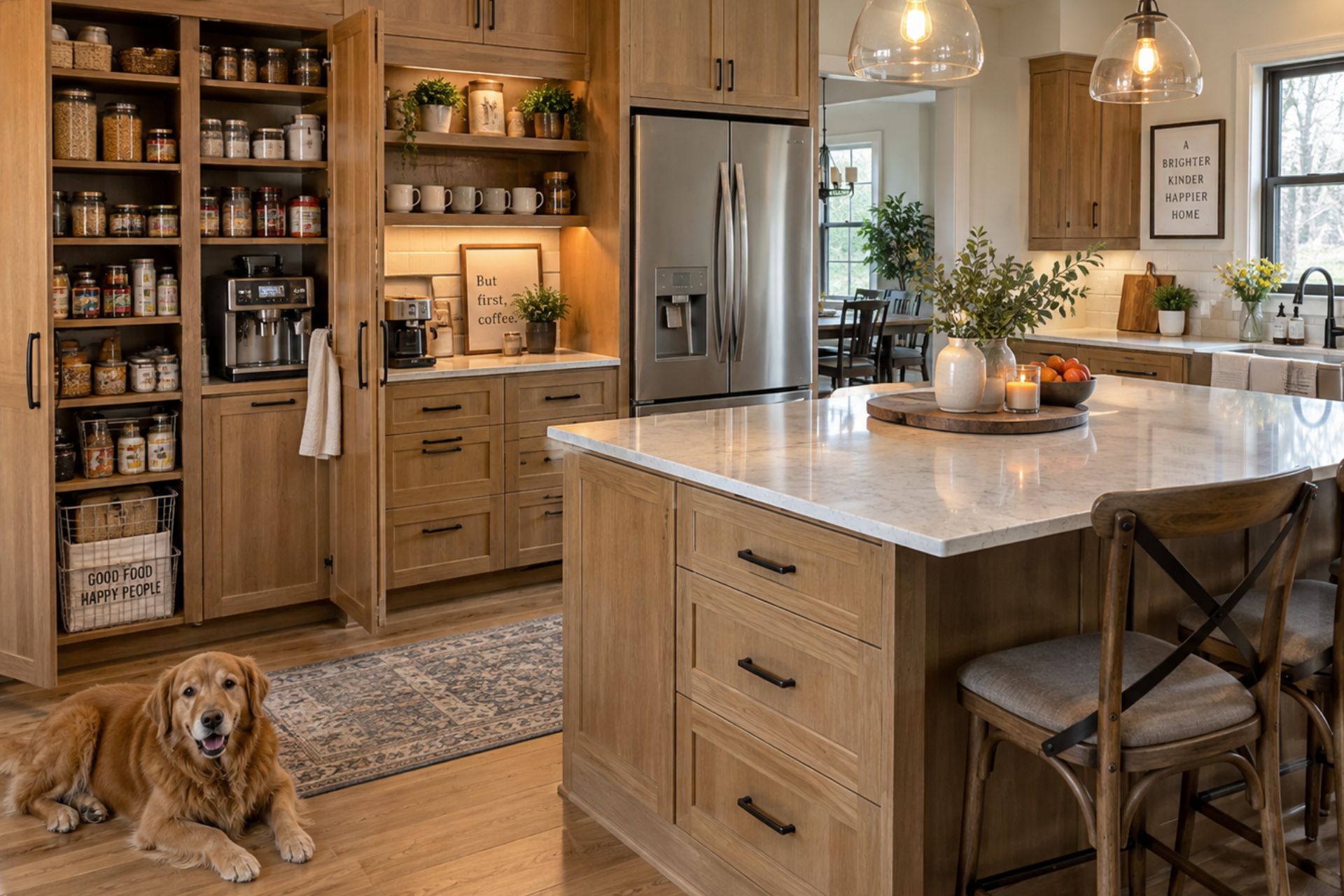
Modern cabinet layouts increasingly support storage, dining and everyday routines within the same kitchen.
Cabinet and Countertop Choices Are Increasingly Connected
Consumers rarely choose wood kitchen cabinets in isolation.
Wood kitchen cabinets color influences the countertop. The countertop influences the backsplash. Flooring and hardware then have to connect the entire room.
As wood cabinetry becomes more visible, material balance becomes especially important.
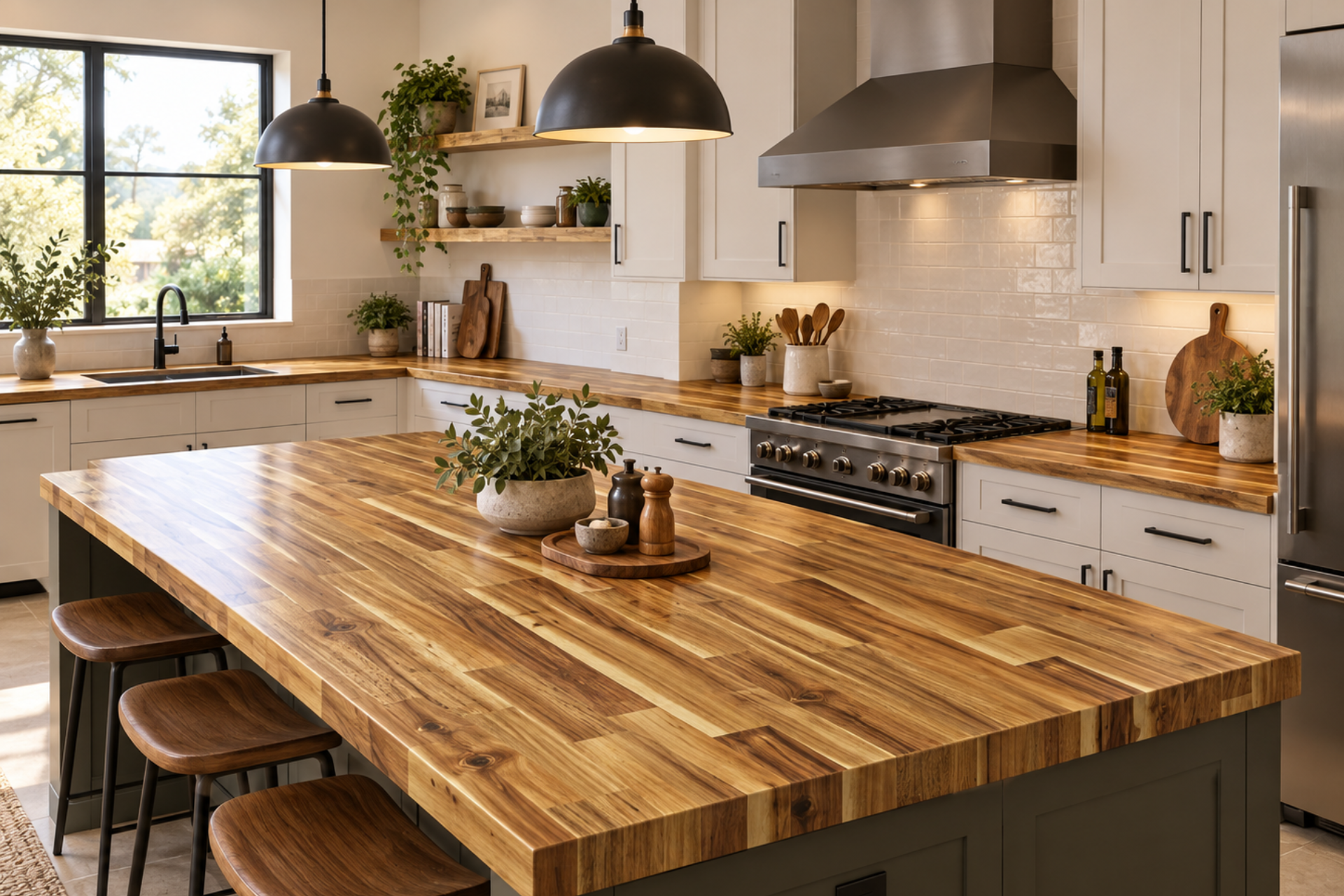
Medium wood cabinets can work with pale stone to keep the kitchen bright. Light wood can sit beside warmer neutrals for a softer contemporary look. Painted cabinetry can also be combined with a natural wood island or butcher block surface to introduce material contrast.
That creates opportunities beyond a single product category.
Retailers, distributors and kitchen companies can think about cabinetry and surfaces as parts of a coordinated program rather than completely separate purchasing decisions.
SSR manufactures cabinet products alongside solid wood panels and butcher block countertops for kitchen and interior applications, making it possible to discuss wood surfaces and cabinet components within a broader program.
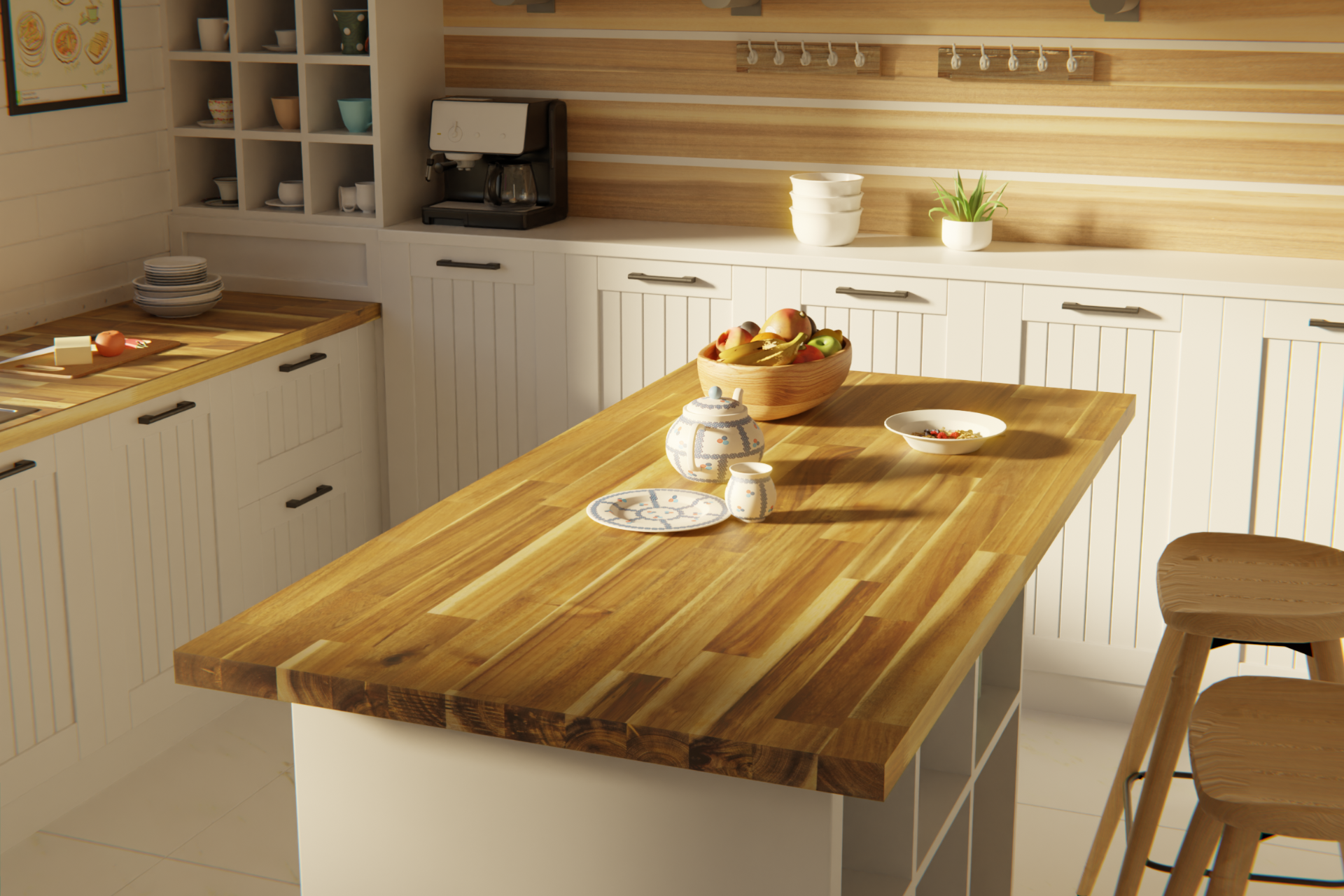
Coordinating cabinetry with countertop materials helps create a clearer kitchen story for both retail displays and consumer inspiration.
A Strong RTA Program Has to Work Beyond the Showroom
The consumer sees a finished kitchen. Retailers, distributors and importers have to manage everything required to get that kitchen there.
This is where a good-looking wood kitchen cabinets collection can become commercially difficult if the underlying program is too complicated.
Multiple cabinet dimensions, door styles, finishes and accessories can quickly create SKU complexity. Packaging has to protect visible surfaces through international transportation. Carton labels need to be easy to identify in a warehouse. Components should also arrive consistently enough that replacement and repeat orders remain manageable.
Those requirements become even more important with RTA wood kitchen cabinets.
The advantage of an RTA program is not simply compact packaging. The system needs to be repeatable across multiple cabinet types and straightforward enough to support distribution, assembly and installation.
SSR positions its cabinet business around factory-direct supply, OEM and ODM development and B2B service, with Base, Tall, Wall and Vanity cabinet categories forming the core of the current RTA range.
For a retailer or distributor, the stronger question is therefore not how many wood kitchen cabinets options a manufacturer can produce.
It is how clearly those options can be turned into a range that consumers understand and the supply chain can repeatedly manage.
Quality Becomes Real After the Kitchen Is Installed
Cabinet performance is experienced every day.
Doors open repeatedly. Drawers carry heavy cookware. Shelves support dishes and appliances. Surfaces are exposed to cleaning, moisture, heat and constant physical contact.
A finish that looks good in a showroom therefore still has to perform in a working kitchen.
This is why established U.S. wood kitchen cabinets performance standards remain relevant to product development.
The ANSI/KCMA A161.1 Performance and Construction Standard for Kitchen and Vanity Cabinets covers areas including cabinet construction and performance under normal installation and use. KCMA describes it as a nationally recognized performance standard for evaluating kitchen and vanity cabinets.
For B2B programs, technical requirements are better addressed during product development rather than after the assortment has already been finalized.
The same applies to material documentation, testing requirements and certifications.
SSR maintains quality and sustainability certifications across its wood manufacturing platform and provides certification information for its RTA cabinet operations.
Different Sales Channels Need Different Cabinet Assortments
The American wood kitchen cabinets market cannot be approached with one universal range.
A home improvement retailer needs cabinet options that consumers can quickly understand and compare. A distributor needs a range that is practical to stock and replenish. Cabinet dealers require enough configurations to build complete layouts. Builders may place greater emphasis on repeatability across multiple homes or projects.
Consumer expectations also change with price positioning.
An entry-level kitchen may prioritize storage, clean styling and affordability. A mid-market renovation may place greater emphasis on door style, finish quality and internal organization. Higher-value projects can introduce more material variation and customization.
The product strategy should reflect those differences.
That may mean using a strong core Shaker program in one channel while introducing natural wood or flat-panel options in another. It may also mean limiting finishes within high-volume retail while allowing more flexibility for cabinet dealers or project customers.
The goal is not to offer the largest possible collection.
It is to create enough choice for consumers while keeping the assortment commercially manageable.
Turning Consumer Demand Into a Stronger U.S. Cabinet Program
The renewed interest in wood kitchen cabinets is part of a larger shift in American kitchens.
Consumers are moving toward warmer materials, but they also expect more storage, cleaner organization and spaces that support more than cooking. Transitional design remains important because it works across different homes, while natural finishes and wood grain are creating new opportunities for contemporary collections.
Those preferences then shape the decisions made further up the supply chain.
Retailers need assortments that consumers can understand. Distributors need configurations that are practical to stock. Importers need repeat production, documentation and packaging that can support larger programs. Cabinet companies need enough flexibility to create kitchens for different layouts without turning every project into a completely new product development process.
A strong wood kitchen cabinets program connects all of those requirements.
SSR’s RTA range includes Base, Wall and Tall cabinets together with several door style directions and OEM/ODM development capabilities for international programs.
Rather than developing wood kitchen cabinets around manufacturing possibilities alone, the starting point should be the kitchen the American consumer wants to live with – then work backward into the right assortment, construction, finish, packaging and supply structure.
Learn more: ssr.vn
Contact: [email protected]