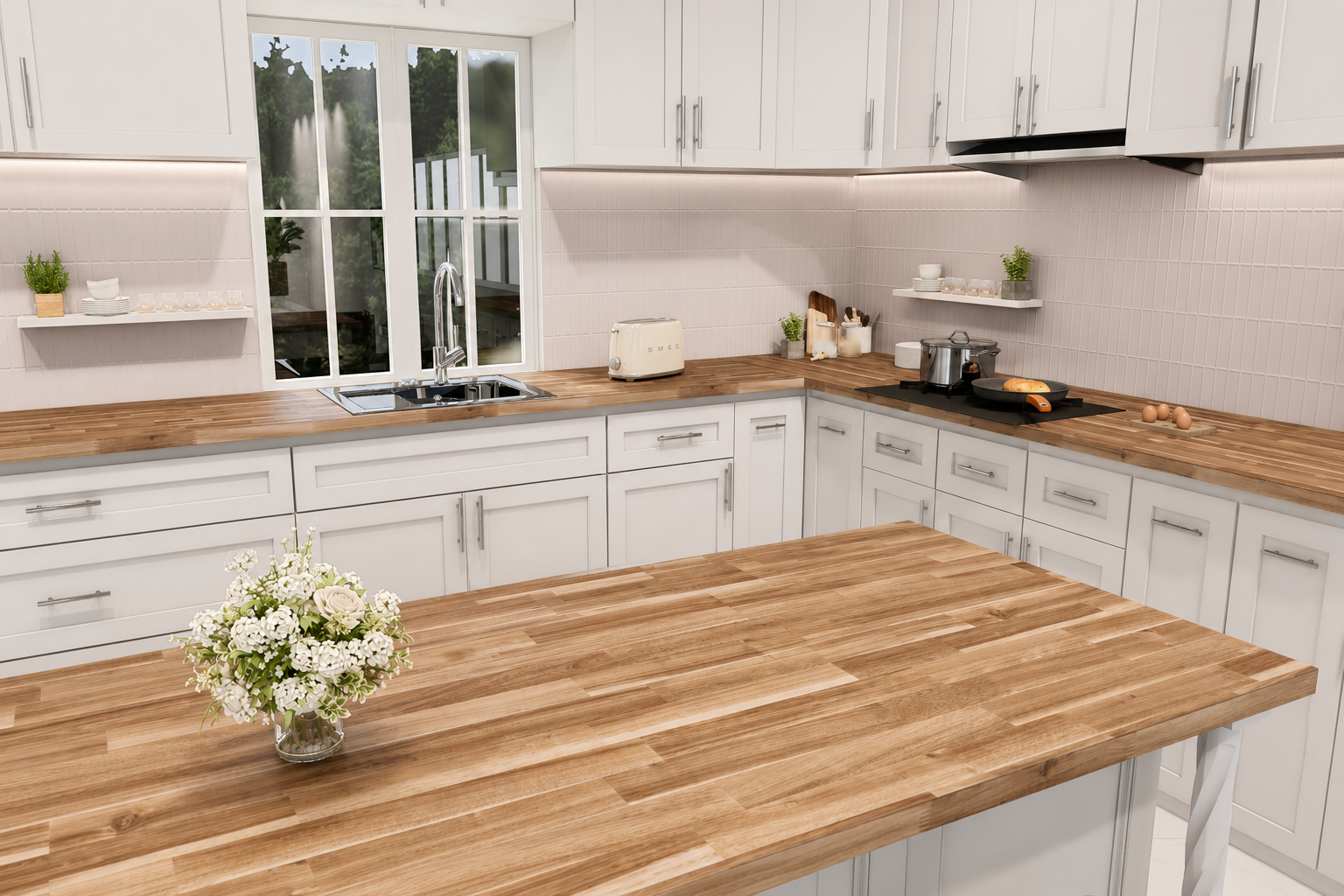
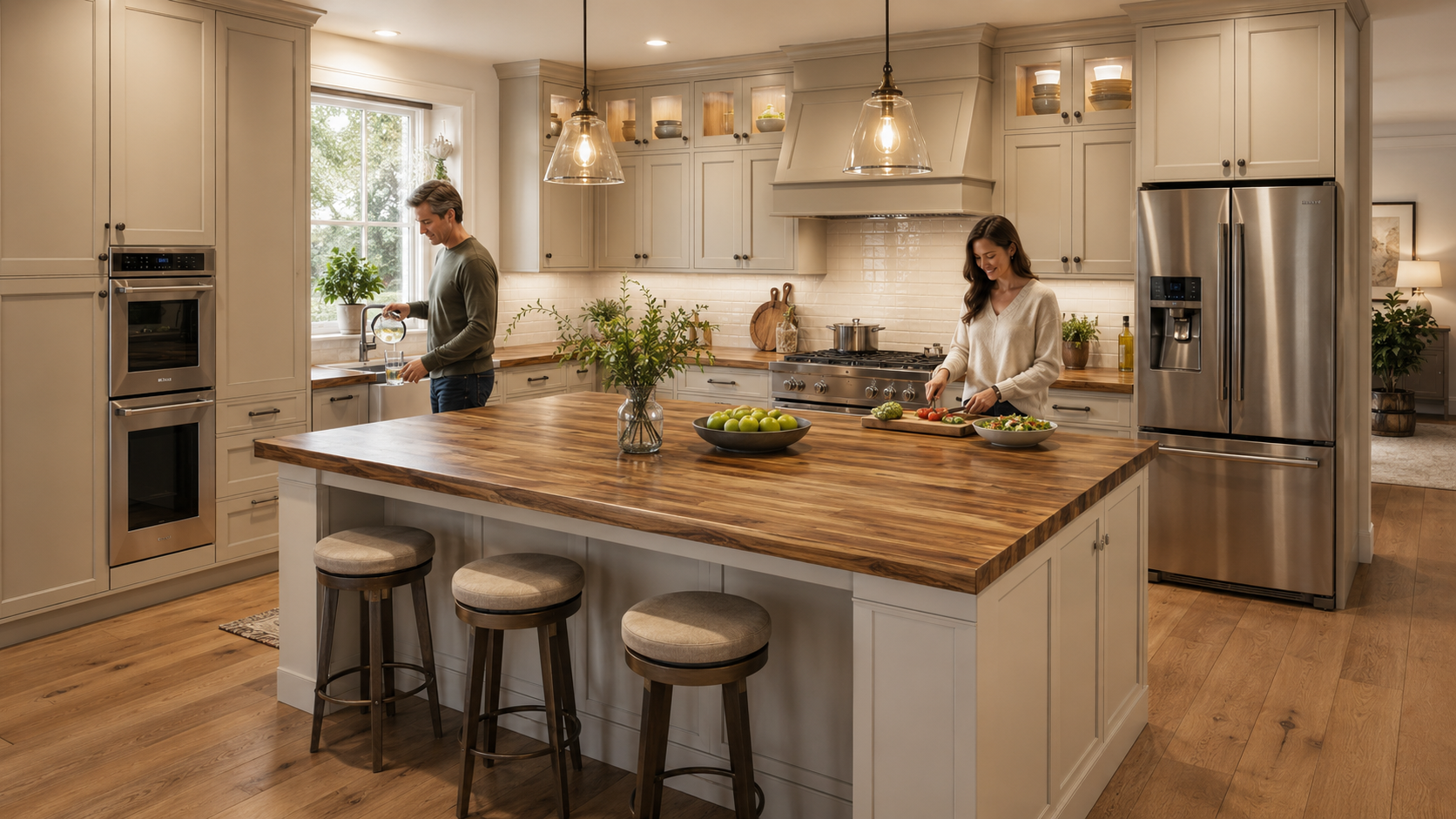
Acacia butcher block is usually introduced as a kitchen countertop, yet the way American households use solid wood surfaces suggests a much larger opportunity. The same material can move from a kitchen perimeter to an island, then into a home office, utility room or workshop without losing the qualities that made it attractive in the first place: visible wood grain, natural warmth, a substantial feel and the flexibility to be adapted to different spaces.
That matters because U.S. remodeling is increasingly centered on how spaces function, not simply how they look. The latest Houzz Kitchen Trends Study, based on 1,780 U.S. homeowners with recent or planned kitchen renovations, found that functionality is becoming a stronger renovation driver, while storage, task-specific zones and built-in features are playing a larger role in kitchen planning. Wood cabinetry has also moved ahead of white as the most selected cabinet color among renovating homeowners. Houzz
NKBA research points in a similar direction. Kitchen professionals surveyed for its trends report expect natural materials, visible wood grain and multipurpose lifestyle spaces to remain important, while islands continue to take on more storage and everyday functions. NKBA
For retailers, distributors and importers, this creates a useful shift in thinking. Instead of treating Acacia butcher block countertops as one isolated product category, Acacia can be developed as a broader wood surface platform built around the places where consumers actually need a durable, attractive working surface.
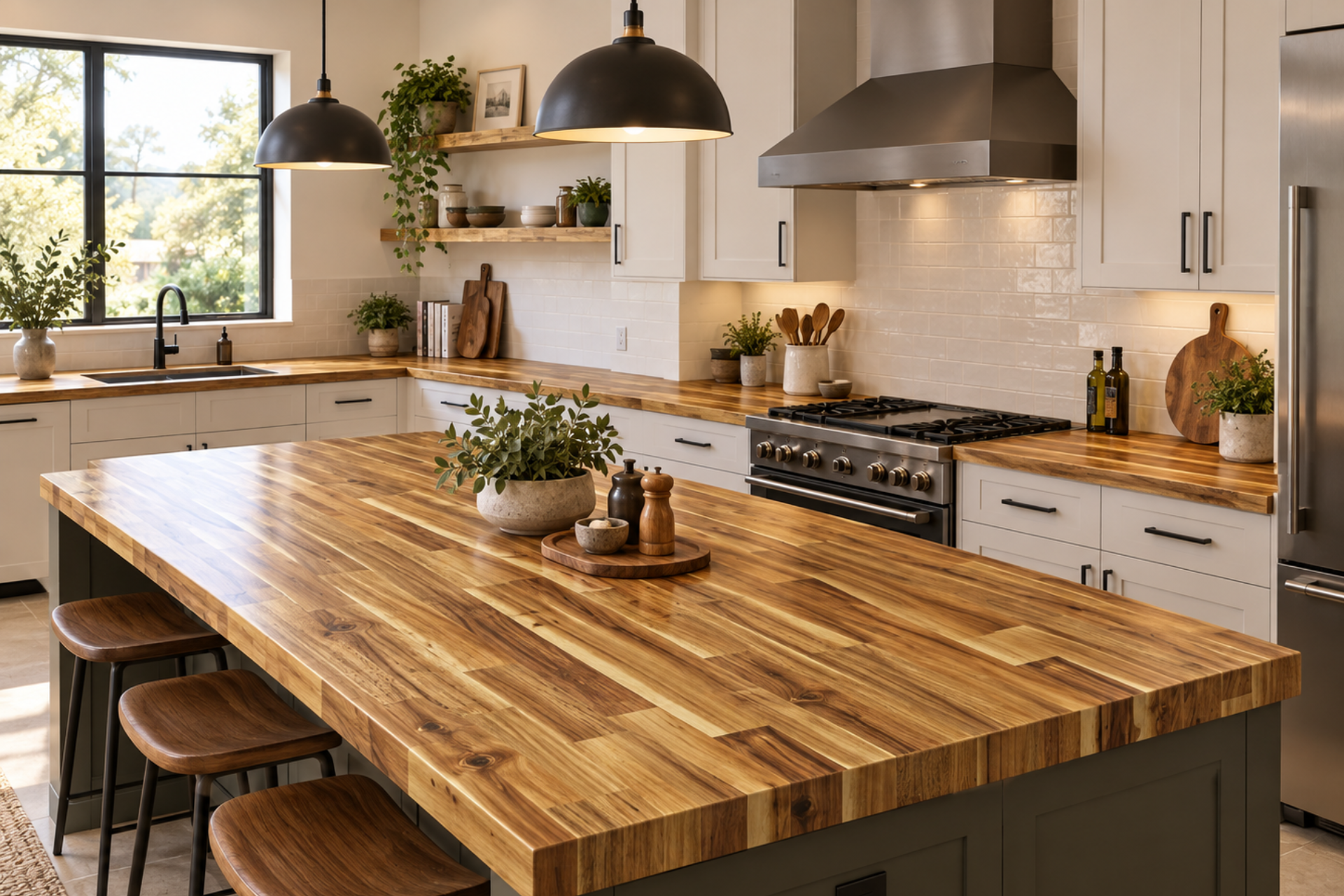
Acacia butcher block wood surface program for U.S. home applications
Start With How the Surface Will Be Used
A conventional assortment often begins with the product name: Kitchen countertop, Desk top, Workbench top, Table top…
From the consumer’s perspective, however, those categories are not always as separate as they appear on a specification sheet. What many of these applications have in common is the need for a surface that feels substantial, looks intentional in the room and can handle everyday use.
That creates an opportunity for Acacia butcher block because the material can remain recognizable even when the application changes.
In the kitchen, it may provide warmth against painted cabinetry or stone. In an office, the same wood character can make a desk feel more like furniture than office equipment. In a workshop, the emphasis shifts toward a solid working surface with the ability to be refinished or adapted over time.
The room changes. The consumer expectation changes. But the material platform can remain closely related.
For a wood surface program, that is more valuable than simply producing a long list of unrelated SKUs.
The Kitchen Remains the Natural Entry Point
The kitchen is still the most familiar place for butcher block in the U.S., and that familiarity gives Acacia an established point of entry into the market.
Current retail assortments show unfinished Acacia butcher block offered in conventional countertop configurations as well as wider island formats. Home Depot, for example, currently lists Acacia products in several lengths and includes a dedicated wider countertop island option within the same category. The Home Depot
That is important because it shows how one material already stretches across more than one kitchen use.
A perimeter countertop is primarily a working surface.
An island often has a broader role.
It may support food preparation, dining, homework, gathering, storage and entertaining within the same footprint. Because of that, the island also carries greater visual weight in the room.
Recent Houzz reporting specifically notes stronger use of butcher block on kitchen islands, while the wider kitchen market is also moving toward warmer wood tones and more natural material character. Houzz
For Acacia butcher block, this creates an especially relevant application. Its variation in grain and tone can help distinguish the island from surrounding surfaces without requiring wood to cover the entire kitchen.
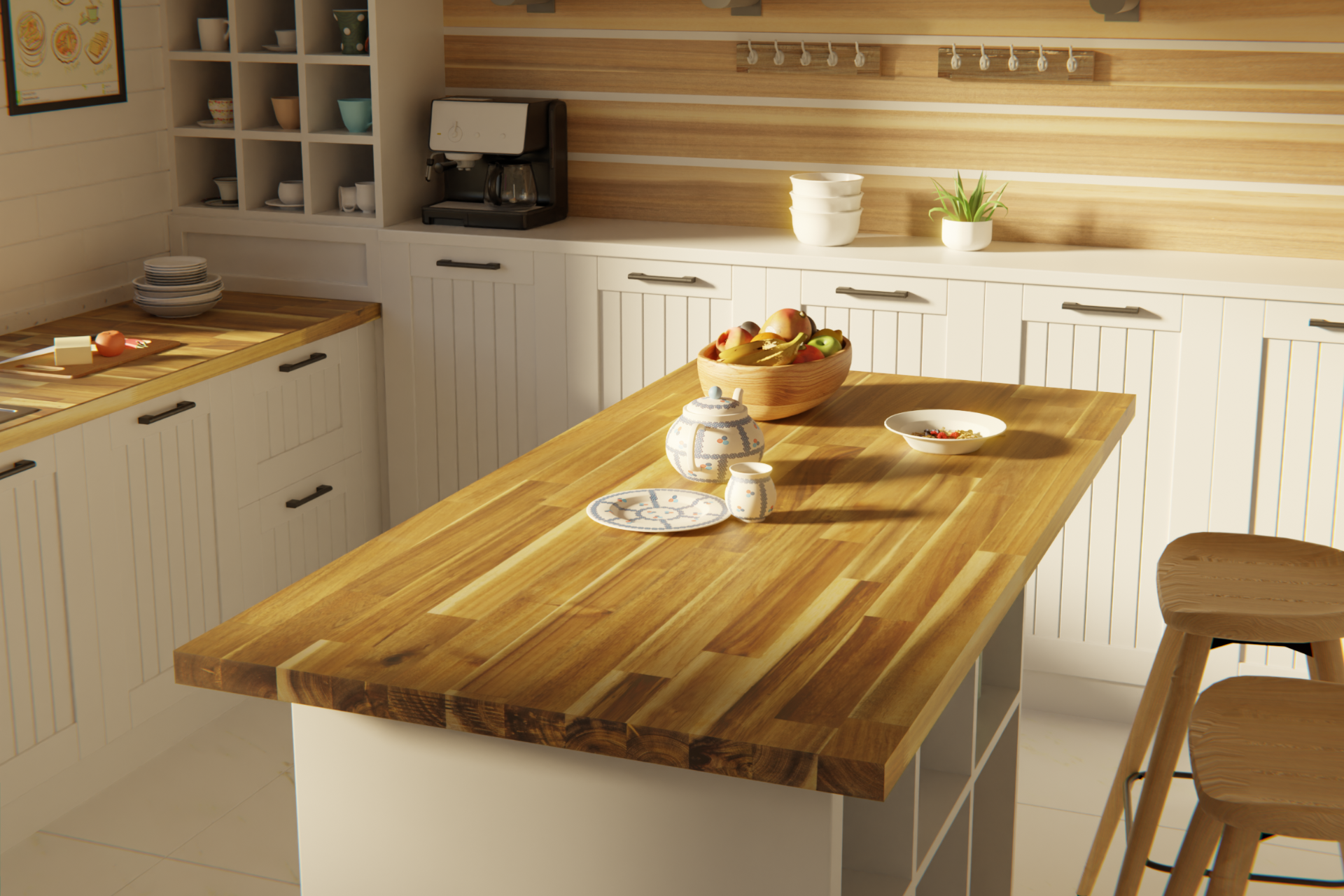
Acacia butcher block kitchen island in a modern U.S. kitchen
The Island Does Not Have to Match Everything
One important consumer shift is that the kitchen no longer has to rely on one material everywhere.
A wood island can intentionally contrast with quartz, natural stone or another solid surface used around the perimeter. In that situation, Acacia is not competing to replace every countertop in the room.
It is being selected because it looks different.
That distinction can help retailers merchandise butcher block in a more relevant way. Instead of positioning the product only as an alternative to stone countertops, it can also be presented as a material used to introduce warmth, texture and visual separation into a mixed-material kitchen.
For the consumer, the product becomes easier to imagine.
For the retailer, the potential application expands.
Acacia Can Move From the Kitchen Into the Home Office
The transition from kitchen countertop to desk top is relatively natural because both applications rely on a broad horizontal work surface.
A solid Acacia wood surface can be paired with simple legs, drawer units or an adjustable standing-desk frame, allowing the finished product to range from a basic DIY workspace to a more considered piece of home-office furniture.
The opportunity here is not necessarily to manufacture an entirely different desk.
It is to allow the same surface platform to support another consumer mission.
Someone shopping for a kitchen countertop is looking at Acacia through the lens of remodeling. Someone searching for a desk top may care more about usable workspace, furniture appearance and the ability to select their own base.
The underlying material can still be closely related.
That gives retailers and distributors another way to extend the commercial use of the surface without turning the assortment into a completely different furniture program.
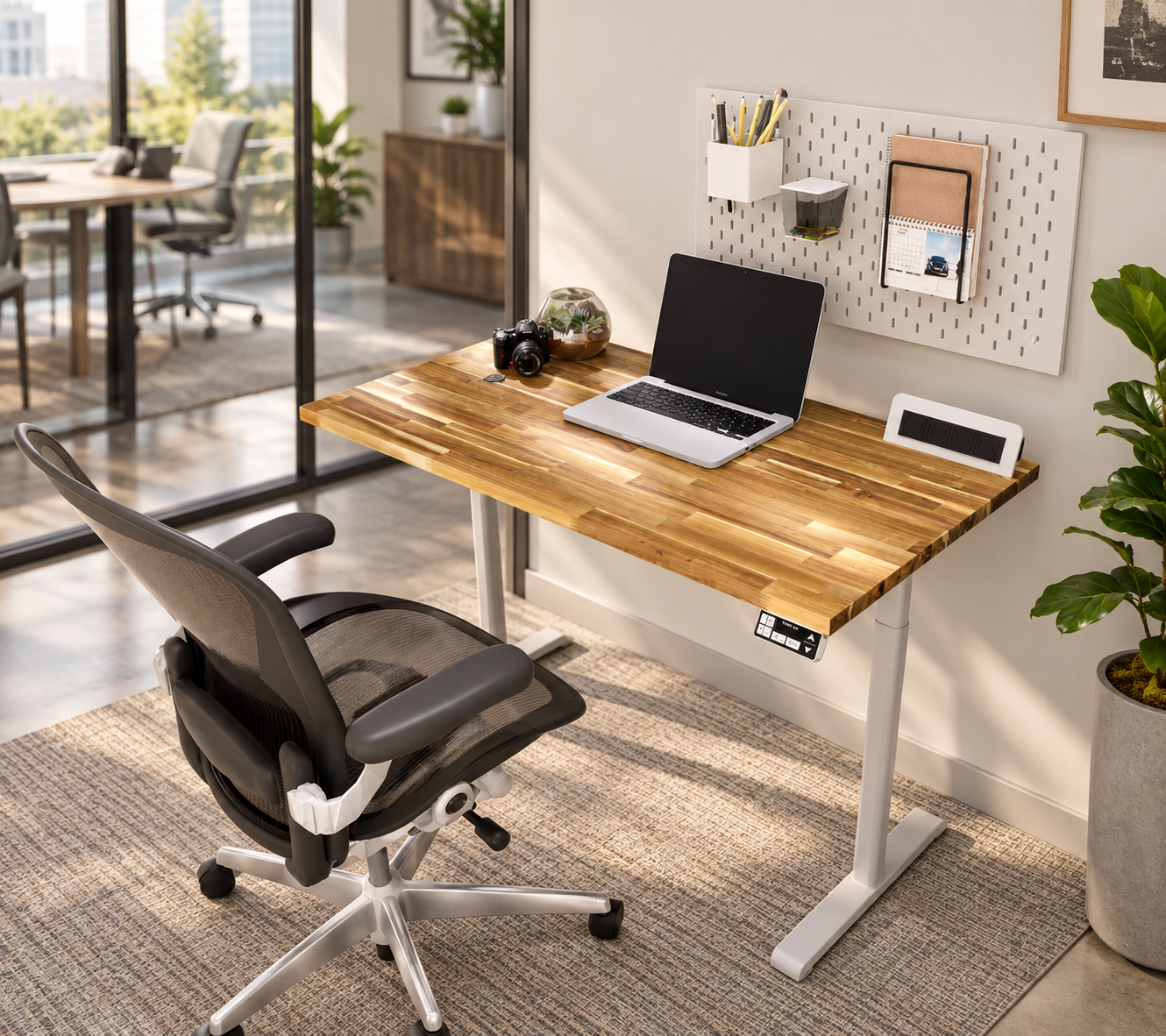
Acacia butcher block desk top for a U.S. home office
The Workshop Changes What Customers Value
A workbench introduces another set of expectations.
Here, decorative appeal still matters, but consumers may place greater emphasis on the feeling of solidity, usable surface area, repairability and the ability to modify the top for their own working environment.
This makes unfinished butcher block countertops particularly interesting.
An unfinished surface gives the customer more influence over what the final product becomes. It can be cut, sealed or finished according to the intended use, whether that means a clean hobby station or a more utilitarian garage workbench.
Current U.S. retail assortments continue to give unfinished Acacia substantial visibility, with multiple lengths and countertop formats offered rather than only one standard configuration. The Home Depot
That continued presence matters because it shows that customization itself remains part of the product’s value.
An unfinished surface is not simply an incomplete finished countertop.
For the right consumer, the ability to decide what happens next is the reason to buy it.

Acacia butcher block workbench top for garage and DIY applications
Utility Spaces Create Another Use for Natural Wood
The same logic extends into laundry rooms, mudrooms, craft areas and other utility spaces.
These rooms increasingly combine storage with dedicated working zones. Houzz reports that task-specific features and additional prep or storage areas are becoming more common in kitchen renovation planning, while NKBA research also points toward more functional adjacent spaces such as mudrooms and flex-use areas. Houzz
A solid wood surface can fit naturally into this type of environment.
In a laundry room, it may become a folding surface over cabinets or appliances.
In a mudroom, it may serve as a worktop above storage.
In a hobby area, it can become a cutting, organizing or project surface.
The important point for an Acacia wood surface program is that these applications do not require the material to reinvent itself each time. They simply require the product to be presented in a context that helps the consumer understand how it can be used.
One Material Can Serve Different Shopping Missions
This is where a wood surface program becomes commercially different from a countertop range.
A countertop range is usually organized around sizes, edges, finishes and perhaps species.
A surface program begins with what the customer is trying to accomplish.
- Someone remodeling a kitchen may need an island.
- Someone furnishing a home office needs a desk top.
- Someone improving a garage may need a workbench.
- Someone upgrading a laundry room may need a folding surface.
These shoppers may never use the same search terms, yet the product behind those applications can come from the same general Acacia butcher block platform.
That creates a stronger merchandising opportunity.
Instead of expecting every customer to understand what can be made from a butcher block panel, retailers can show the product in the environments where it becomes useful.
The material remains consistent. The message changes with the application.
A Better Program Does Not Mean More SKUs
There is an important distinction here.
Turning Acacia into a broader surface program should not automatically mean adding dozens of dimensions, finishes and colors.
Too much variation can make the assortment harder to understand, forecast and replenish.
A stronger starting point is usually a focused group of recognizable applications supported by a manageable product structure.
- Kitchen countertop.
- Kitchen island.
- Desk top.
- Workbench.
- Utility surface.
The exact assortment can vary by channel, but each option should have a clear reason to exist.
This keeps product development connected to demand rather than production possibility.
For an importer or retailer, the question becomes less about: What else can the factory make? and more about: Which additional application gives this surface a meaningful reason to be purchased? That is a much healthier foundation for assortment growth.
Finished and Unfinished Surfaces Should Solve Different Problems
The U.S. market also gives room for two different product directions.
Unfinished Acacia for Customization
Unfinished products are useful when consumers want control.
They may want to select a stain that matches cabinetry, apply their preferred finish or modify the panel before installation.
Home Depot’s current Acacia assortment includes multiple unfinished formats and lengths, reinforcing the role of customization in the category. The Home Depot
For DIY-oriented and home-improvement channels, that flexibility can be a major part of the product proposition.
Finished Acacia for Simplicity
Other consumers want fewer steps between purchase and use.
For them, the appeal lies in a more predictable appearance, less finishing work and a clearer idea of what the product will look like after installation.
That makes surface consistency, color control and finish quality more important.
A good assortment does not need to declare one direction superior.
They address different customer expectations.
Understanding which expectation dominates each sales channel is more useful than simply offering every possible finish.
Visual Consistency Becomes More Important as the Program Expands
Acacia naturally contains variation, and that variation is part of its appeal.
The challenge comes when the same material begins appearing across several applications.
If a kitchen island, desk top and utility surface are presented as part of the same program, the products should feel related even if no two panels look exactly alike.
This requires balance.
Too much uniformity can remove the natural character that makes wood attractive.
Too much variation can make the assortment feel disconnected.
For retailers, visual consistency affects more than quality control. It influences how easily products can be photographed together, merchandised as a family and reordered over time.
For the Acacia butcher block supplier, this makes material selection, grading, sanding and finishing part of the commercial result, not simply the production process.
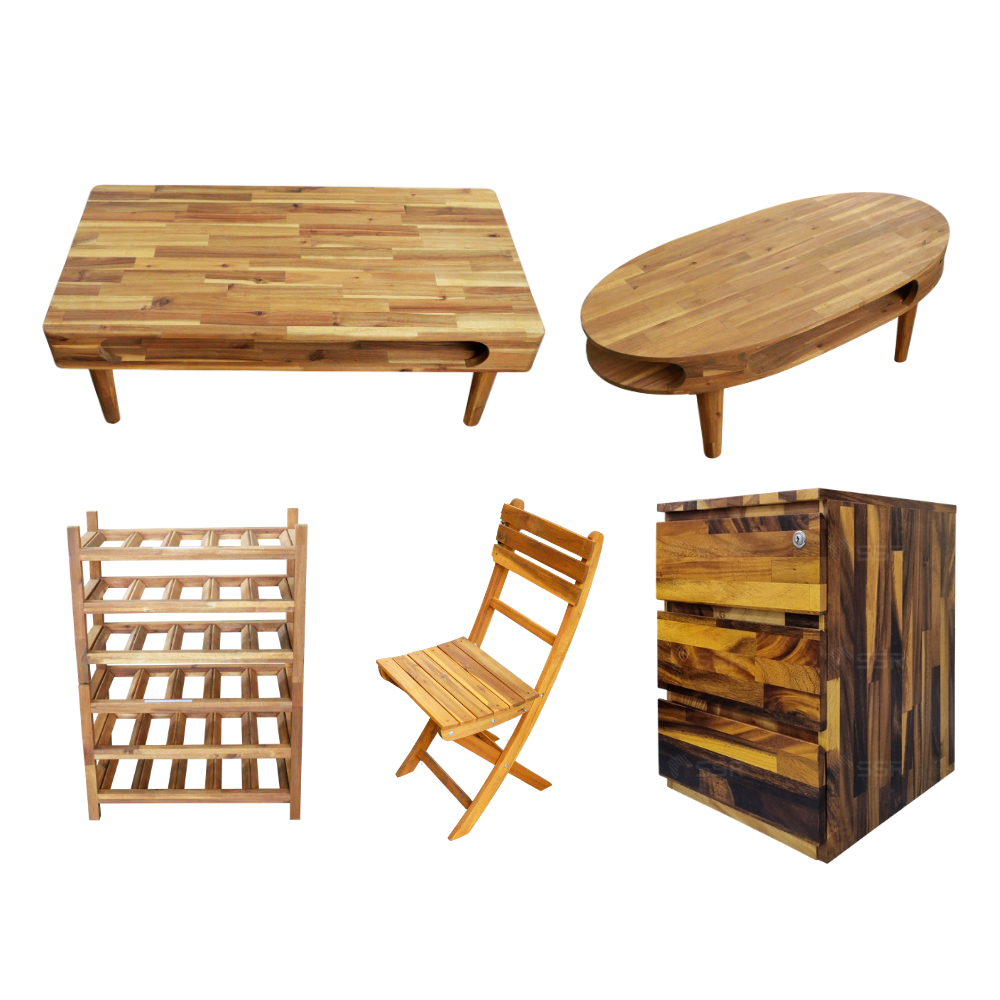
Consistent Acacia butcher block surfaces across multiple applications
Online Merchandising Needs to Sell the Application
This is particularly important in e-commerce.
A plain product photograph can show grain, edge quality and overall color, but it does not always answer the first question a consumer has:
- What can I do with this?
- A kitchen image answers that for a kitchen shopper.
- A standing desk answers it for someone planning a workspace.
- A garage setup answers it for someone looking for a workbench.
The same Acacia surface may therefore benefit from several groups of application photography, even when the underlying product is closely related.
This supports both SEO and conversion because the content can connect to a wider set of search behaviors:
- Acacia butcher block countertops
- butcher block kitchen island
- butcher block desk top
- butcher block workbench top
- wood laundry countertop
Instead of forcing one product page to rank for everything, a broader content and internal-linking structure can build topical relevance around the entire Acacia surface category.
Packaging Needs to Follow the Sales Channel
A multi-application program also changes how the product moves.
A kitchen countertop may travel through a distributor or kitchen program.
A desk top may be sold through e-commerce.
A workbench top may sit in warehouse inventory and experience repeated physical handling.
The wood may be similar, but the route to the customer is not.
Packaging therefore needs to account for the actual journey rather than simply meeting a generic export requirement.
Large wood panels are especially vulnerable at edges and corners, while surface scratches can alter the first impression before the product is ever installed.
For online orders, packaging also has to survive more touchpoints before the customer opens it.
This is why packaging becomes part of the product program itself.
The quality standard does not end when the panel passes factory inspection.
It ends when the customer receives the surface in the expected condition.
Repeatability Keeps a Surface Program Together
A successful range also needs continuity over time.
If a retailer develops an Acacia kitchen island today and introduces a related desk or workbench later, the products should still feel as though they belong to the same material family.
That becomes harder if later production shifts noticeably in tone, finishing or surface character.
Repeatability therefore supports more than replenishment.
It supports the ability to grow the assortment.
A reliable Acacia butcher block supplier should be able to maintain an agreed visual and quality direction as the program moves from one application into several.
This is especially relevant for importers and distributors working across repeat container orders, where the commercial value of consistency becomes clearer over time than it is in a single initial sample.
What a Wood Surface Program Needs From a Supplier
Developing a broader program does not require the supplier to decide what the retailer should sell.
It does require the supplier to understand how manufacturing choices affect what happens in the market.
That includes knowing how appearance should remain controlled across larger production volumes, how different finishing directions change the consumer proposition, how packaging should respond to the channel and how repeat production can remain aligned with the original assortment.
It also means having enough flexibility to develop applications without turning customization into unnecessary complexity.
For wholesale butcher block countertops and related wood surfaces, the most useful manufacturing partner is therefore not simply the one that can make the greatest number of options.
It is the one that can help translate a clear product direction into repeatable production.
Acacia Butcher Block Becomes More Valuable When the Application Expands
The opportunity around Acacia butcher block is broader than one kitchen countertop.
Its recognizable grain, warm color variation and adaptable surface format allow the material to move naturally from kitchens into islands, offices, garages and utility areas.
The U.S. market already gives evidence of this flexibility through the continued presence of unfinished Acacia products, dedicated island formats and a broader remodeling shift toward natural materials and more functional spaces. Houzz
For retailers, importers and distributors, this makes Acacia worth considering as a material platform rather than only as another countertop SKU.
The stronger question is not necessarily:
How many Acacia products should be added?
It is:
Which applications allow one Acacia surface program to serve more of the ways customers are actually using their homes?
SSR develops Acacia butcher block countertops and related wood surfaces for programs built around application, repeat production, finishing and packaging requirements for international markets.
Discuss your Acacia wood surface program with SSR Corporation and explore how one material platform can support multiple applications for the U.S. market.
Frequently Asked Questions
What can Acacia butcher block be used for besides kitchen countertops?
Acacia butcher block can be adapted for kitchen islands, desk tops, workbench tops, table tops, laundry-room surfaces and other utility or home-improvement applications.
Is Acacia butcher block suitable for a kitchen island?
Yes. Wider Acacia butcher block products are already sold specifically for kitchen island applications in the U.S. retail market.
Why are unfinished Acacia butcher block countertops popular for DIY applications?
An unfinished surface gives consumers more control over cutting, staining, sealing and final appearance, allowing one panel to be adapted to different projects.
What is the difference between a countertop program and a wood surface program?
A countertop program is usually built around one primary application. A wood surface program uses a related material platform across multiple applications such as countertops, islands, desks, workbenches and utility surfaces.
What should retailers consider when expanding an Acacia butcher block range?
Application demand, visual consistency, finished versus unfinished positioning, packaging, repeat-order consistency and how clearly each product solves a consumer need are more important than simply adding more SKUs.
What should buyers look for in an Acacia butcher block supplier?
Key considerations include surface consistency, production repeatability, finishing capability, packaging support and the ability to adapt the material across clearly defined applications without compromising the overall product direction.