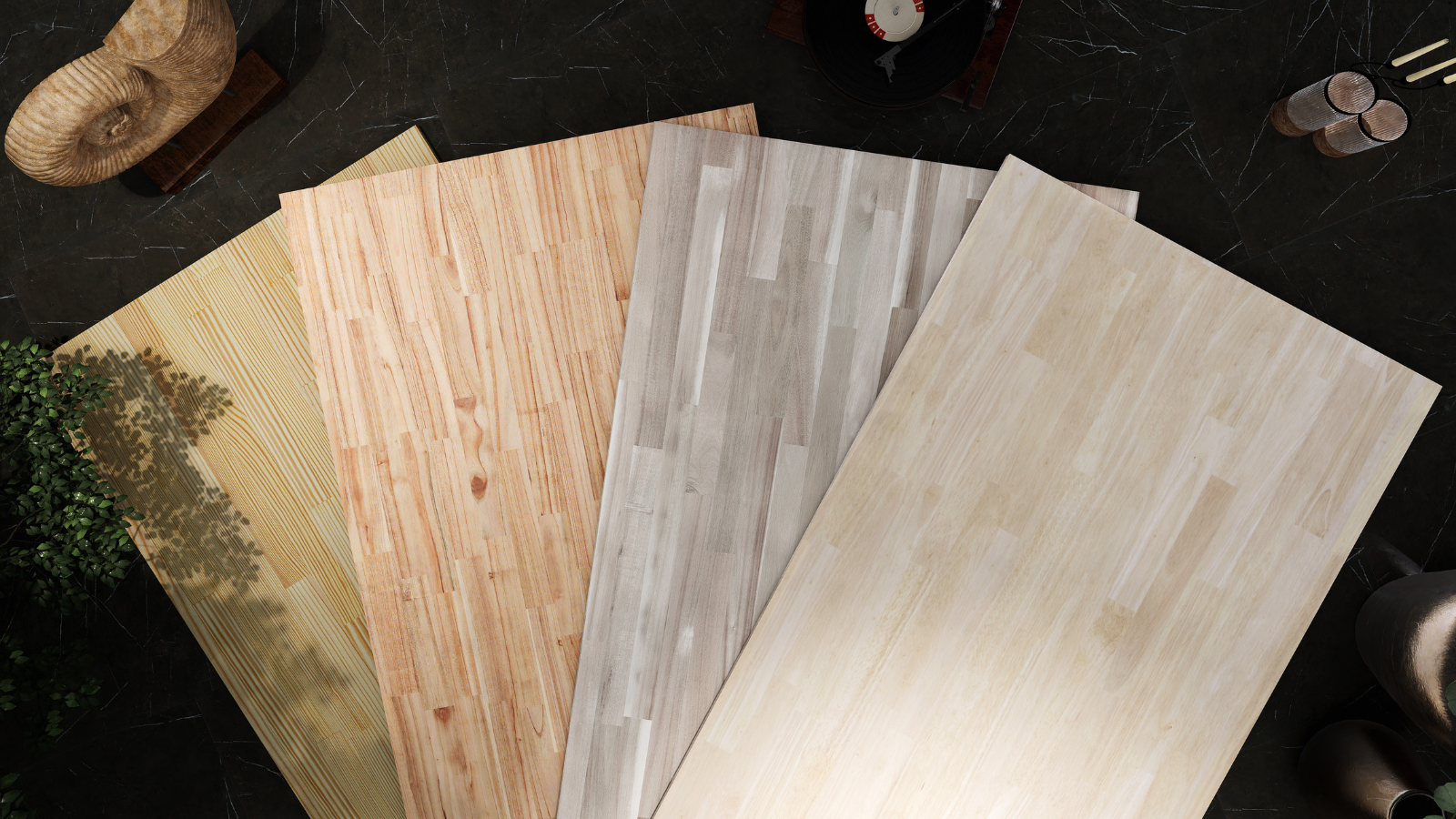
Rubberwood Butcher Block appeals to consumers for reasons that go well beyond the wood species itself. What they see first is a natural solid wood surface with a relatively light appearance, visible grain and enough versatility to fit into kitchens, workspaces, furniture and other everyday parts of the home.
Also known as Hevea, Rubberwood sits in an interesting position within the wood surface category. It delivers the warmth people expect from real wood without the heavier visual contrast of some darker or more expressive hardwoods, while its relatively neutral character leaves room for different stains, finishes and interior styles.
That flexibility is already visible in major home-improvement assortments. Hevea is currently sold in unfinished countertop formats, wider island tops and other solid-wood surface configurations, while European home-improvement retail also carries raw, finger-jointed Hevea worktops intended to be cut and finished around the project.
For product programs, this reveals an important consumer behavior: people are not necessarily looking for one fixed “Rubberwood product.” They are looking for a natural wood surface that can fit the way they want to use their home.
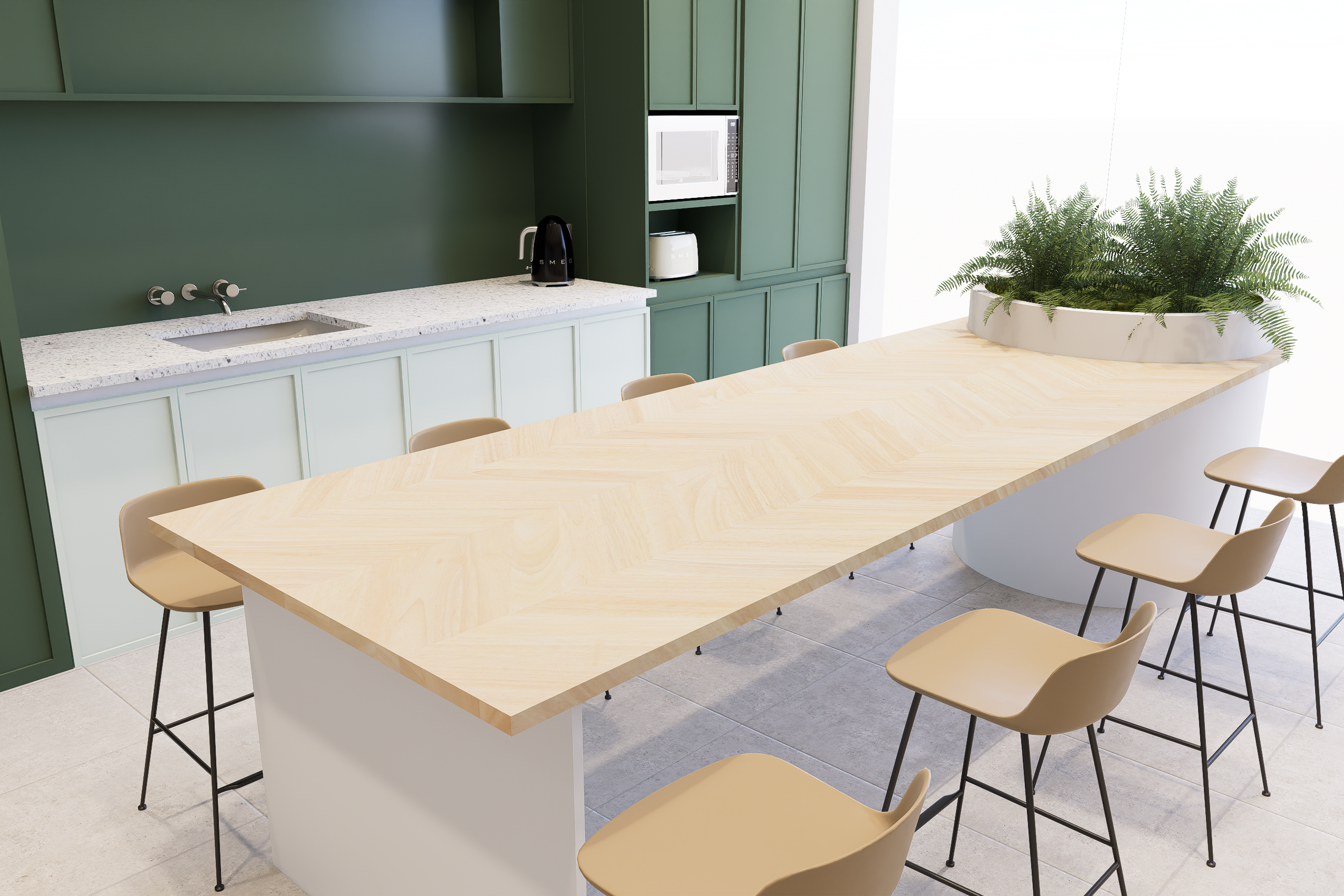
Rubberwood Butcher Block countertop in a bright modern kitchen
Natural Wood Has to Bring Warmth Without Taking Over the Room
One of the strongest reasons people choose wood is the way it changes the atmosphere of a space. Wood adds warmth, texture and a more natural character alongside painted cabinetry, stone, metal and other engineered surfaces.
Natural wood has become increasingly relevant in home interiors because consumers are looking for spaces that feel warmer, more tactile and less visually uniform. Recent kitchen research supports this direction: NKBA reports that wood grain is gaining popularity in cabinetry, while organic and natural design remains one of the major kitchen directions expected to grow.
This shift creates a natural place for Rubberwood Butcher Block. Its lighter tone and relatively restrained grain allow consumers to bring real wood into the room without making the interior feel too dark or visually heavy. The surface can sit comfortably beside painted cabinetry, stone, metal appliances or other wood tones while still adding visible natural character.
The Kitchen Is Often the Starting Point, Not the Limit
Butcher block remains closely associated with kitchen countertops, and for good reason. It is one of the places where consumers interact most directly with a large wood surface.
Yet the way people use butcher block has expanded beyond the idea of covering every perimeter countertop with the same material.
Wood may appear only on an island. It may create a breakfast bar. It may cover a smaller preparation zone. Or it may become the warm surface that contrasts intentionally with stone or engineered materials elsewhere in the room.
Current retail assortments reflect that flexibility. Unfinished Hevea is available not only as conventional countertop material but also in wider island formats, making the material suitable for different kitchen layouts rather than one fixed configuration. This changes how Rubberwood Butcher Block should be presented. It is not only an alternative countertop material. It can also become a design element.
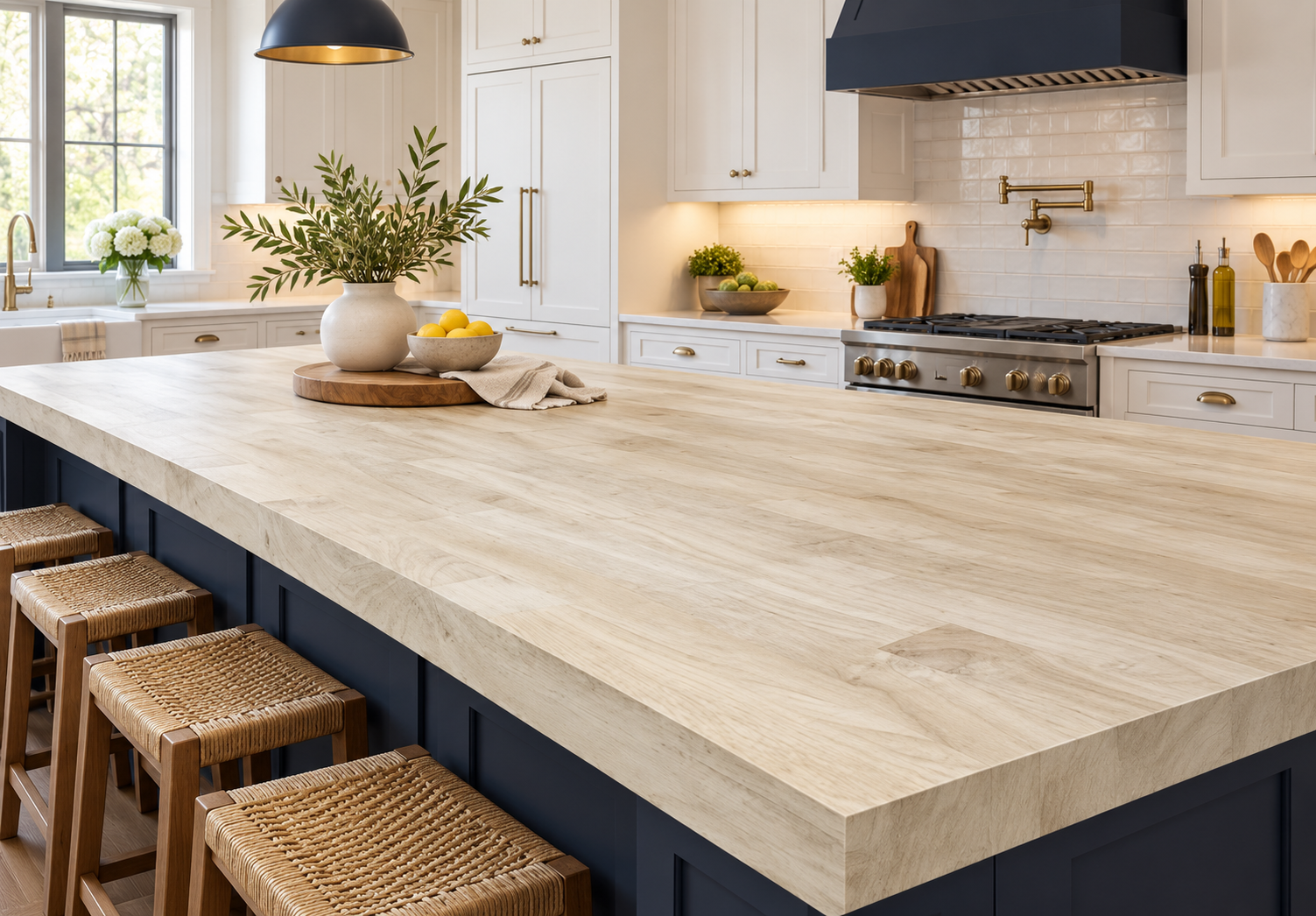
Rubberwood butcher block kitchen island with mixed countertop materials
A Kitchen Island Lets Wood Play a More Emotional Role
The island often carries more visual attention than other surfaces in the kitchen.
It may be where people eat breakfast, prepare meals, work on a laptop, gather with friends or spend time with family. Because it sits in the middle of the room, its material choice affects how the entire space feels.
A butcher block kitchen island can introduce warmth without requiring consumers to commit to wood across the whole kitchen. Rubberwood suits this application particularly well because the surface has enough natural character to distinguish itself from surrounding materials while remaining visually calm.
The result can feel warmer than stone without becoming overly traditional. That gives retailers and brands a useful way to communicate the product: rather than showing only an empty countertop, lifestyle photography can show how the surface becomes part of everyday life. The consumer is not simply buying wood. They are imagining what happens around it.
Unfinished Wood Gives Consumers More Control
One of the most interesting signals in current retail assortments is the continued presence of unfinished Hevea.
Major home-improvement retailers sell unfinished Hevea butcher block across multiple sizes and formats, including conventional countertops and island surfaces. In France, solid Hevea worktops are also sold raw, allowing the surface to be treated after purchase.
This matters because unfinished does not necessarily mean incomplete.
For some consumers, it means flexibility. They can decide whether the wood should remain light or become warmer. They can choose an oil, stain or protective finish. They can cut the panel to fit an existing layout. They can coordinate it with cabinetry or furniture already in the home. They may even buy a product originally categorized as a worktop and use it for something completely different.
That ability to participate in the final result is especially relevant to DIY and renovation-oriented consumers. A fixed finished product tells them what the surface will be. An unfinished Hevea butcher block gives them room to decide.
Other Consumers Want a Product That Is Already Resolved
Customization has value, but convenience has value too. Some people do not want to select a stain, research coatings or finish a wood surface themselves. They want to know what the product will look like when they purchase it and how much work remains before it can be used.
For these consumers, factory-finished Rubberwood solves a different problem. The value comes from greater predictability: the color has already been established, the surface already has a defined feel, and fewer finishing decisions remain after purchase.
This creates two legitimate product directions rather than one being better than the other. Unfinished Rubberwood Butcher Block serves people who value adaptability. Finished Rubberwood serves people who value simplicity. A strong assortment should make this distinction easy to understand instead of presenting both as minor variations of the same SKU.
What Consumers See Online Becomes the Product They Expect
Natural wood creates a particular challenge in online shopping because the material is naturally variable, while digital photography presents consumers with a fixed visual reference. A customer may see one tone, one grain balance and one overall level of variation, and that image quickly becomes the product they expect to receive.
If the delivered surface looks significantly darker, more contrasted or visibly different, natural variation can easily be interpreted as inconsistency rather than authenticity. Rubberwood’s relatively balanced color can help reduce this gap, but the species alone cannot guarantee a consistent visual experience.
Material selection, grading, photography and production control still need to work together so that the product shown online reflects the realistic appearance consumers are likely to receive. This is especially important for retailers and e-commerce programs, where customers may never see the physical surface before purchase, making visual consistency not only a matter of appearance, but also an important part of trust.
Consumers Notice the Surface Before They Notice the Specification
Most consumers will never know which sanding sequence was used, how the wood strips were selected or how the panel was pressed, but they will notice the final result almost immediately. Surface smoothness, clean joint lines, properly finished edges, visible glue marks and overall color consistency all influence whether Rubberwood butcher block countertops feel refined or inexpensive when seen and touched in the home.
A panel may meet basic technical specifications and still fall short of consumer expectations if these visible details are not carefully controlled. On the other hand, a well-prepared Hevea surface can make its relatively simple natural grain feel cleaner, more considered and more premium. Ultimately, consumers judge the product through the surface they can see and use every day, which means manufacturing quality needs to translate directly into the finished experience.
Maintenance Has to Feel Manageable, Not Technical
Wood countertops naturally raise practical questions about water resistance, sealing, staining, scratching, cleaning and whether the surface can be sanded or refinished over time. These concerns can strongly influence whether consumers feel comfortable choosing real wood over materials they perceive as easier to maintain.
For Rubberwood Butcher Block, clear care information is therefore an important part of the product experience, particularly for unfinished Hevea surfaces that may require oiling, sealing or another protective treatment before use. Consumers should understand what preparation is needed, how the surface should be cleaned and protected in everyday use, and what options are available when normal wear eventually appears.
When maintenance is explained clearly, natural wood feels more manageable and predictable; when that guidance is missing, normal characteristics of wood can easily be interpreted as product problems.
Real Wood Has an Advantage When the Surface Ages
A natural wood surface will naturally change with use over time, and for many consumers, that evolving appearance is part of its appeal. Small marks, subtle changes in tone and other signs of everyday use can give Rubberwood Butcher Block a character that feels different from highly uniform synthetic surfaces.
More importantly, real wood can often be maintained rather than simply replaced; depending on the finish and condition, a solid wood worktop may be lightly sanded and refinished to restore its appearance or extend its usable life. This changes the value conversation, because consumers are not only comparing how materials look on installation day, but also how they may perform and age several years later.
A surface that can be maintained, repaired or refreshed offers a different ownership experience from one where visible damage is difficult to correct, making long-term flexibility an important part of the product story while still acknowledging that natural wood requires proper care.
The Same Surface Can Leave the Kitchen Completely
One of the strongest opportunities for Rubberwood is that the product does not depend entirely on kitchens.
The qualities people value in a countertop-large usable area, real wood appearance and finishing flexibility-also make sense in other applications.
A Rubberwood panel can become:
- a desk top,
- a dining or utility table,
- a workbench,
- a laundry-room surface,
- a vanity top,
- a craft table,
- or another furniture surface.
Retail assortment data already demonstrates some of this crossover. Hevea butcher block is sold in countertop and island formats, while solid Hevea worktops are positioned as adaptable wood surfaces rather than a purely decorative kitchen product. This opens a broader way to merchandise the material. Someone searching for a desk may never search “Rubberwood countertop.” Someone building a workbench may never visit a kitchen category. Yet the underlying surface may answer both needs.
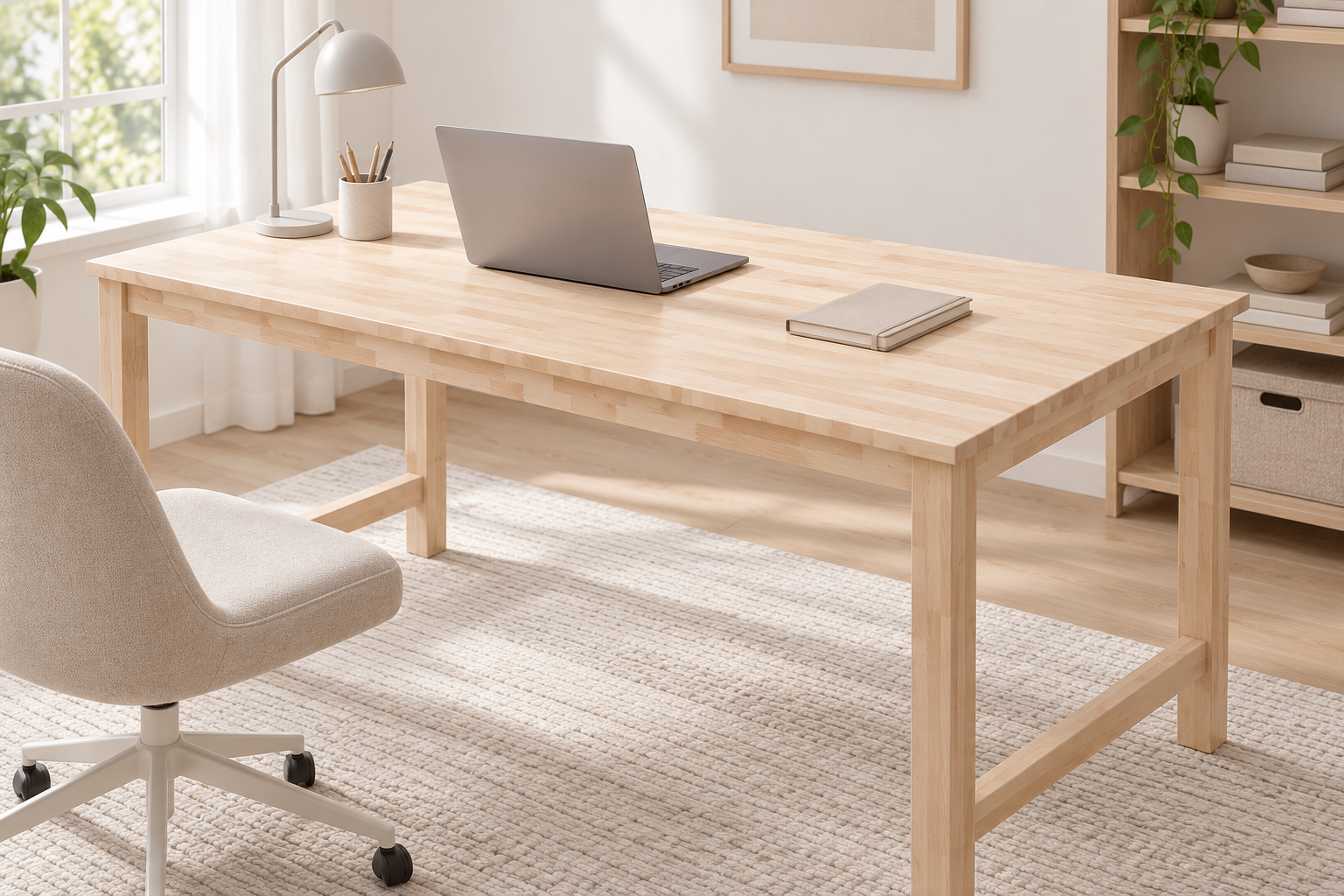
Light Hevea butcher block desk in a modern home office
Workspaces Reveal the Practical Side of Rubberwood
A desktop or workbench changes the way consumers evaluate a wood surface because the priorities are different from those of a kitchen countertop. Instead of focusing on coordination with sinks, backsplashes or cabinetry, they are more likely to consider usable surface area, visual comfort, compatibility with the desk or bench structure and how the material will perform during everyday use.
In a home office, a lighter Rubberwood desk top can introduce the warmth of natural wood without making the workspace feel visually heavy, while in a workshop the same material may be valued more for solidity, repairability and the ability to sand, refinish or modify the surface over time.
These applications show why Rubberwood should not be positioned too narrowly as a kitchen material, since the same wood surface can move naturally between decorative and functional roles depending on how it is designed, finished and presented.

Rubberwood butcher block workbench top for home projects
Flexibility Does Not Mean Consumers Want Endless Choices
More options do not automatically create a better buying experience, especially when too many stains, edge profiles, dimensions and product variations make the assortment difficult to compare.
Consumers usually need enough choice to find the right product for their project rather than every configuration a manufacturer is capable of producing. A clearer Rubberwood Butcher Block assortment can therefore be organized around recognizable use cases, such as a standard worktop, a wider island surface, an unfinished DIY option, a ready-finished version or a desk and utility format. Giving each product a distinct purpose helps consumers understand the differences more quickly, which is particularly important in e-commerce where several near-identical listings can easily create confusion.
The strongest assortment is not necessarily the one with the most options, but the one that makes it easy for consumers to identify which surface best fits how they plan to use it.
Product Quality Becomes Most Visible After Installation
Some quality issues are difficult to recognize while the product is still packaged because their impact only becomes visible after installation and everyday use. Moisture control is a good example: consumers do not choose Rubberwood Butcher Block based on a moisture-content figure, but they do expect the surface to remain reasonably stable once installed.
If the wood moves excessively, warps or develops dimensional problems, the technical cause quickly becomes a customer complaint. The same principle applies to visual consistency across related pieces, since two countertops or adjoining surfaces that differ too much in tone, grain balance or finish can feel mismatched even when each piece individually falls within a natural variation range.
For this reason, production controls around moisture, grading, sanding and finishing need to work together to support the experience promised at retail. These technical factors may not be the main selling point of the product, but they play a critical role in ensuring that the finished surface continues to meet consumer expectations after installation.
Packaging Protects the First Impression
A large wood surface can pass through factory handling, container loading, warehouses, distribution centers, stores and parcel delivery before it finally becomes part of a home, and at every stage the visible face, edges and corners are exposed to potential damage.
From the consumer’s perspective, however, that supply chain is invisible; they simply open the package and expect a new product to arrive in good condition. A scratched surface, crushed corner or damaged edge can immediately reduce the perceived value of Rubberwood Butcher Block, even before installation begins.
Packaging therefore needs to protect the areas that matter most when the product is unpacked, including the face, edges, corners and overall surface condition. This is especially important for unfinished Hevea, where the consumer may plan to apply a clear or natural finish that keeps the wood fully visible, leaving little opportunity to hide shipping damage beneath an opaque coating.
The Material Name Is Only Part of the Buying Decision
Rubberwood may not have the same immediate name recognition as oak, walnut or maple, but that does not reduce its potential within the wood surface category.
Many consumers begin their search with the result they want rather than a specific species, looking for products such as a light wood countertop, a butcher block island, an unfinished solid wood worktop, a natural desktop or a surface they can stain and customize themselves.
Rubberwood Butcher Block can meet these needs even when the customer did not initially search for Hevea by name.
For product communication, this means the material should be clearly identified, but the story should go beyond simply stating that the surface is made from Rubberwood.
Consumers need to understand what that choice means in practice: a lighter natural appearance, flexibility in finishing, suitability across multiple applications and the ability to bring real wood into different interior styles without making the space feel overly heavy or visually dominant.
A Strong Rubberwood Program Begins With How People Will Use It
For retailers, distributors and brands, understanding how consumers will use the product helps determine which manufacturing details deserve the most attention. A Rubberwood Butcher Block sold through e-commerce needs strong visual consistency and protective packaging, while a DIY-oriented product may depend more on clean unfinished quality and the flexibility to be cut, stained or finished after purchase.
A kitchen island requires careful control of appearance across a large visible surface, whereas desks, furniture and other applications need enough consistency for different products to still feel part of the same material family.
This is where the role of the supplier becomes more important, because consumers may never think about moisture control, grading, sanding or production repeatability, yet these factors directly influence whether the product they receive matches the appearance and performance they expected. A reliable Rubberwood butcher block supplier therefore needs to understand not only how to manufacture the panel, but also how the surface will be sold, used and experienced after it leaves the factory.
Rubberwood Butcher Block Works Because It Leaves Room for the Consumer
The strongest quality of Rubberwood Butcher Block may be that it does not force the product into one narrow identity.
Its lighter natural appearance can work in kitchens without overwhelming the room.
It can become an island when consumers want wood only as an accent.
It can remain unfinished for people who want control over the final look.
It can be factory finished for those who want convenience.
And the same solid wood surface can move beyond the kitchen into desks, tables, workbenches and utility spaces.
That makes Hevea valuable not only as a wood species, but as a flexible surface platform.
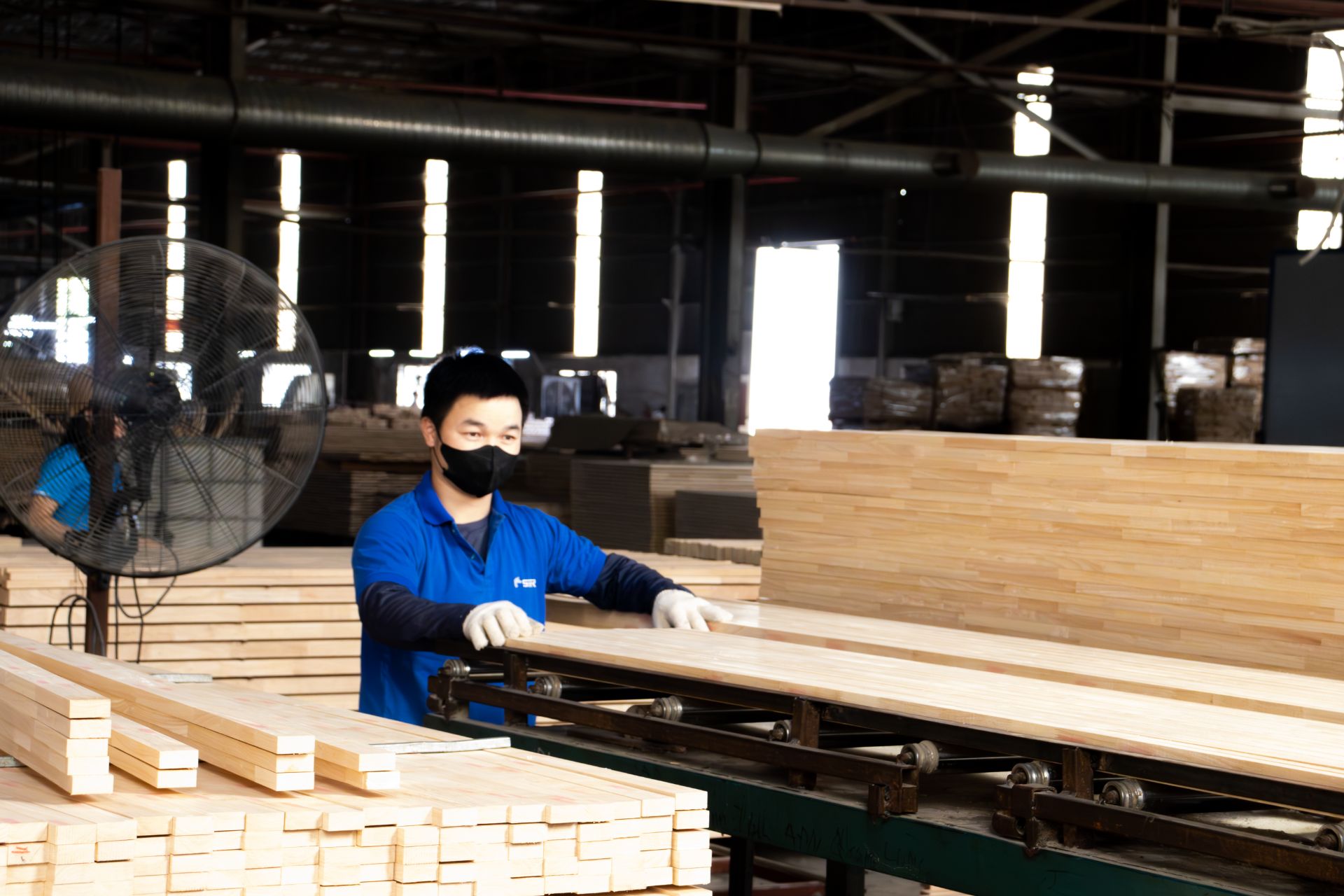
SSR develops Rubberwood/Hevea butcher block and related Wood Surface products around the requirements that ultimately shape this consumer experience: surface consistency, finishing, moisture control, packaging and repeat production.
For the next Rubberwood Butcher Block program, start with how customers want to use the surface—and build the product around that experience.
Frequently Asked Questions
Is Rubberwood the same as Hevea?
Yes. Rubberwood comes from the Hevea brasiliensis tree, which is why Rubberwood, Hevea and Heveawood are commonly used to describe the same wood material.
What is Rubberwood Butcher Block used for?
Rubberwood Butcher Block can be used for kitchen countertops, islands, desk tops, workbenches, tables, vanity tops and other household wood surfaces.
Why does Rubberwood work well for natural wood surfaces?
Its generally lighter color and relatively restrained grain make it easier to combine with different cabinetry, furniture and interior materials while still providing the warmth of real wood.
Can Rubberwood Butcher Block be sold unfinished?
Yes. Unfinished Hevea butcher block is currently offered through major home-improvement retail channels, allowing consumers to choose their own stain, oil or other surface treatment.
Why would consumers choose an unfinished wood surface?
An unfinished surface gives greater control over color, finish and customization, which can be useful for DIY projects or installations that need to coordinate with existing materials.
Can Rubberwood Butcher Block be used for a kitchen island?
Yes. Hevea is currently sold in dedicated wider island formats as well as standard countertop formats.
Is Rubberwood suitable for a desk or workbench?
Yes. The same solid wood panel format can work for desks, workbenches and other utility surfaces when the construction, dimensions and finishing are appropriate for the application.
What should a good Rubberwood surface look like?
Natural variation is expected, but consumers generally benefit from an overall appearance that remains recognizable across color, grain, jointing, sanding and finish.