Rubberwood Butcher Block offers something many consumers want from a natural wood surface: visible grain and warmth without an appearance that feels too dark, rustic or visually dominant. Also known as Hevea wood, Rubberwood typically has a lighter, relatively balanced character that allows the material to move easily between kitchens, workspaces, furniture and utility areas.
That versatility matters because consumers rarely think about a wood surface only in terms of species. They think about how it will look beside their cabinets, whether it will work on an island, whether they can customize the finish, how difficult it will be to maintain and whether the same type of surface could work somewhere else in the home.
For that reason, the value of Rubberwood goes beyond being another countertop material. A well-developed Hevea butcher block can become a flexible natural wood surface for multiple everyday applications.
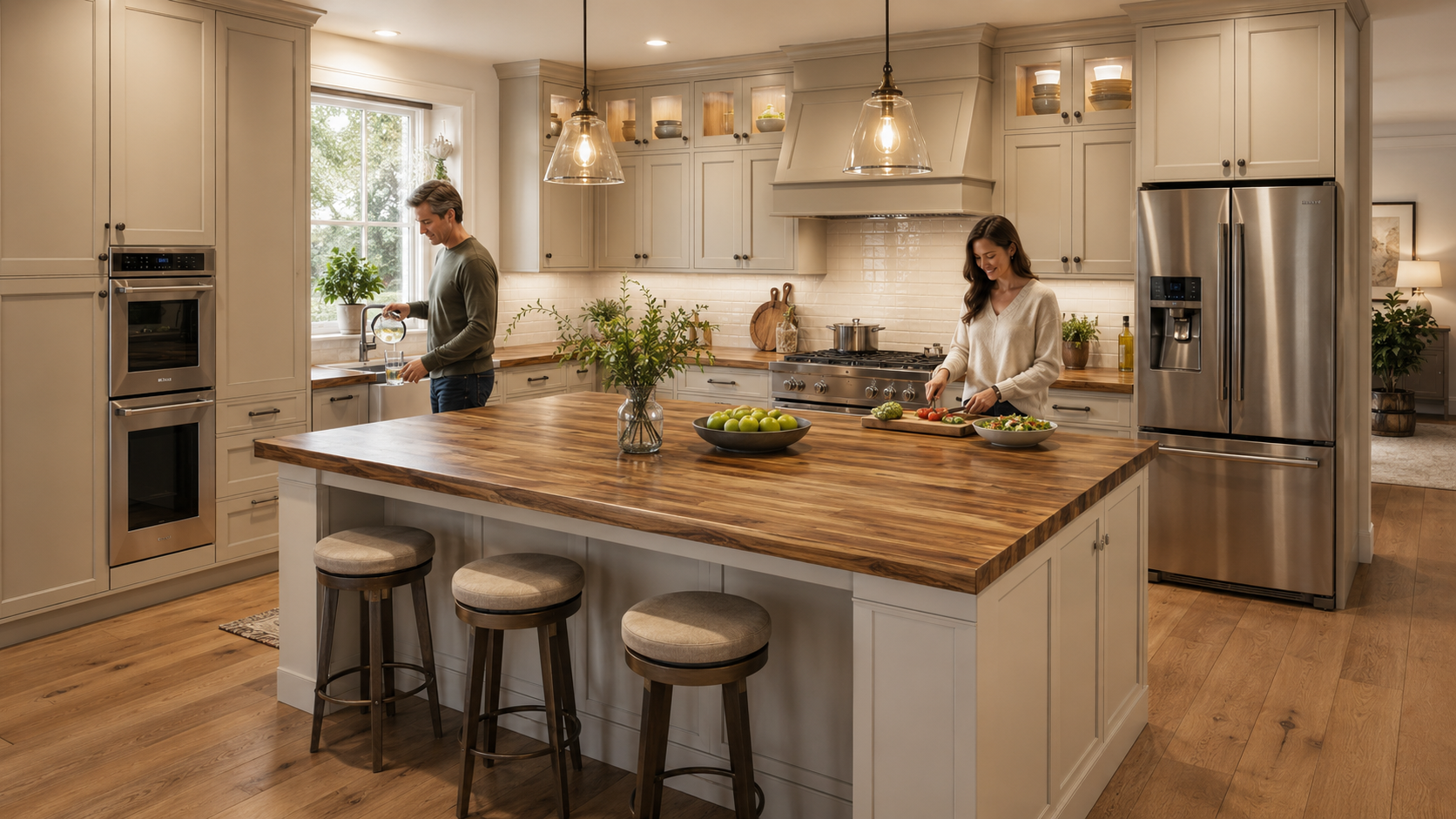
Rubberwood Butcher Block countertop in a bright modern kitchen
A Natural Wood Look That Does Not Overwhelm the Room
Real wood brings warmth into an interior, but not every consumer wants a surface with strong color contrast or dramatic grain movement. In many homes, the countertop needs to complement cabinetry, flooring, walls and furniture rather than become the dominant visual feature.
This is where Rubberwood Butcher Block has a useful advantage. Its naturally lighter appearance and relatively subtle grain can create visible wood character while keeping the overall room calm and balanced. A Rubberwood surface can sit beside white or painted cabinetry, darker hardware, stone, tile or other wood tones without making the design feel overly heavy.
The result is a material that can move between different interior styles more easily. It can feel clean in a contemporary kitchen, warm in a transitional interior and simple enough for a minimalist workspace.
Consumers still get the tactile and visual qualities of natural wood, but in a form that can adapt to the rest of the home.
Rubberwood and Hevea Are the Same Wood Material
The two names often create confusion when consumers or product teams first encounter the material. Rubberwood comes from Hevea brasiliensis, which is why the terms Rubberwood, Hevea wood and sometimes Heveawood are used within the wood and furniture industries.
Rubber trees are originally cultivated for latex production. Once their productive latex cycle declines, the wood can be processed into useful products rather than leaving the tree with no further material value. The Food and Agriculture Organization of the United Nations describes Rubberwood as a versatile material that has become established in furniture and wood-based products, while also noting its ability to take stains and finishes well. FAOHome
This is a useful characteristic when the same Hevea wood surface needs to support more than one product direction. The base wood can retain a natural light appearance or move toward different finishing styles depending on how the final surface will be used.
Consumers Are Looking for More Than a Kitchen Countertop
The kitchen remains an obvious home for butcher block, but consumers increasingly encounter solid wood panels as adaptable surfaces rather than products with only one purpose.
A person may first consider Rubberwood butcher block countertops during a kitchen renovation, then recognize that a similar surface could work on a kitchen island, desk, table, workbench or utility cabinet. The value of the material therefore grows when consumers can clearly understand what else they can do with it.
This is particularly relevant for natural wood because the material does not inherently belong to one room. A well-finished panel can look refined enough for a kitchen or home office, while an unfinished version can move easily into DIY and workshop applications.
The opportunity is not simply to make one surface serve every purpose. It is to show how the same material character can respond to different needs.
Kitchen Countertops Remain the Most Familiar Starting Point
For many consumers, a kitchen countertop is where butcher block first becomes relevant. Wood introduces warmth into a room that may otherwise contain painted cabinets, metal appliances, stone, engineered surfaces and tile.
A Rubberwood countertop can work particularly well in this environment because its lighter tone adds natural texture without making the kitchen visually heavy. The surface can cover the main working area, appear as a smaller accent or become part of a mixed-material kitchen.
Consumer expectations, however, go beyond appearance. A countertop is touched, cleaned and viewed closely every day, which means sanding quality, edge condition, joint alignment and finishing quickly become part of the product experience.
A natural material may contain grain variation, but the finished surface still needs to feel intentional and refined.
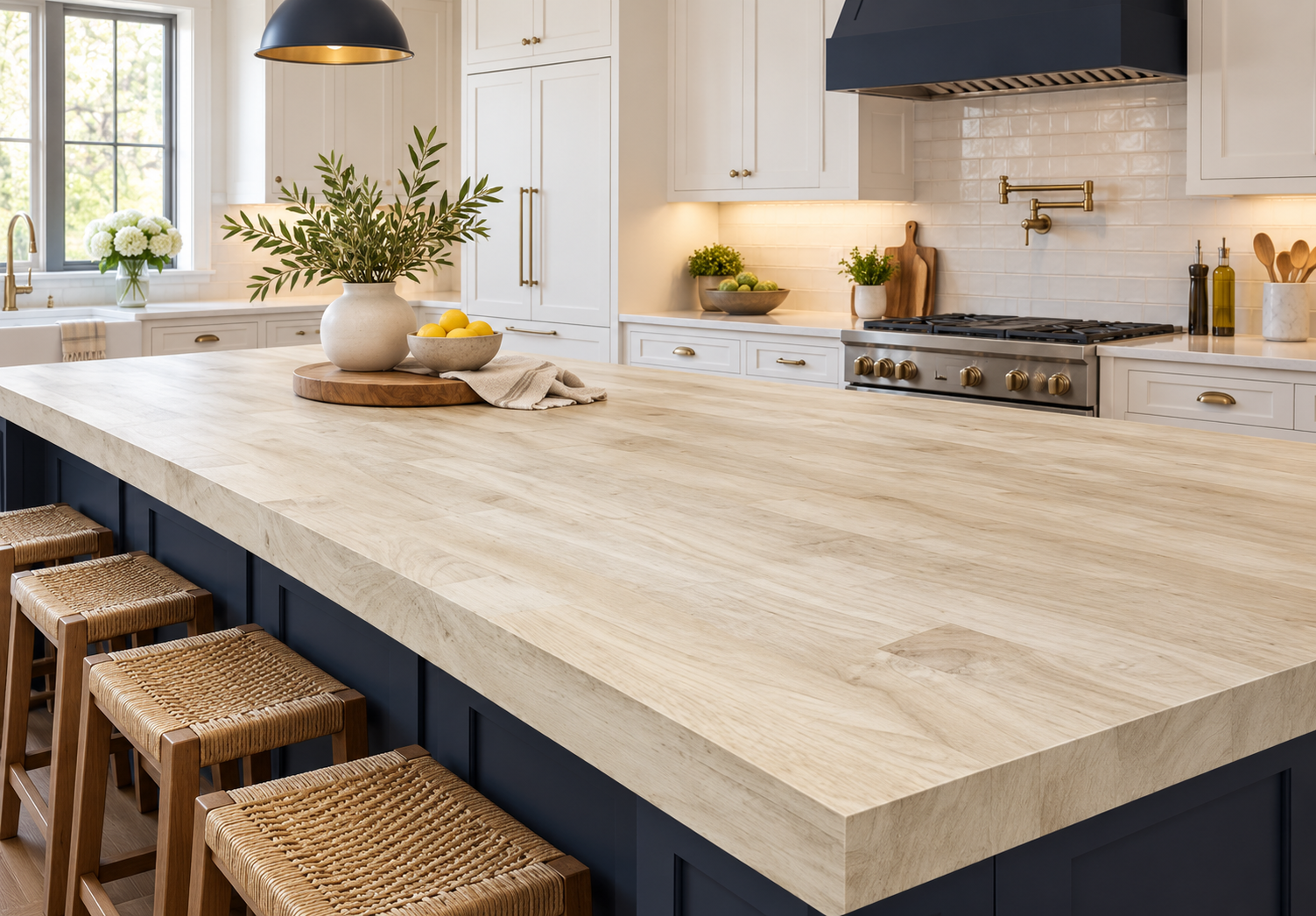
Rubberwood butcher block countertops with light kitchen cabinetry
Kitchen Islands Give Rubberwood a Different Role
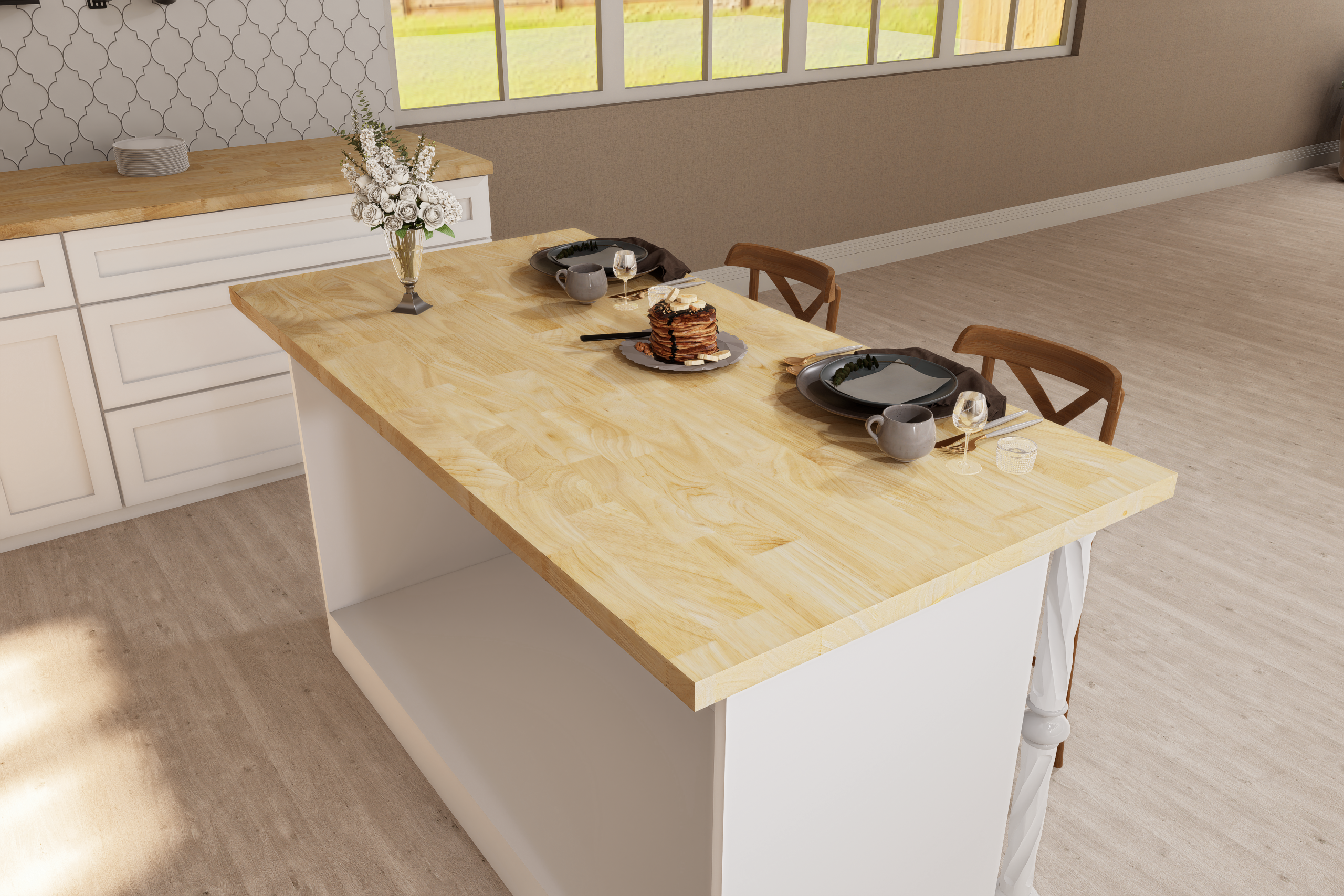
A butcher block kitchen island can serve a different purpose from the countertops around the perimeter of the kitchen. Rather than trying to make every surface match, consumers may deliberately use wood on the island to introduce contrast and make the center of the room feel warmer.
Rubberwood is well suited to this approach because the grain remains visible without becoming excessively dramatic. A lighter Hevea butcher block island can contrast against stone or engineered countertops while still coordinating with surrounding cabinetry and furniture.
The island also tends to be more than a food-preparation area. It may function as a place for eating, gathering, working or spending time with family, which gives the surface a more visible lifestyle role.
For the consumer, wood becomes part of how the room feels rather than simply what the countertop is made from.
Finished or Unfinished Depends on How Consumers Want to Use It
One of the useful characteristics of Rubberwood is that the product does not have to follow only one finishing direction.
An unfinished Rubberwood butcher block appeals to consumers who want greater control over the final surface. They may want to stain the wood to coordinate with cabinetry, apply a preferred oil or protective coating, cut the panel for a custom project or simply choose how natural the finished product should look.
A factory-finished surface solves a different problem. It reduces the number of decisions required after purchase and gives consumers a clearer expectation of how the product will look once installed.
Neither direction is inherently better. Someone building a DIY desk may value customization, while someone replacing a kitchen surface may prefer a more complete product.
Understanding this difference is important because consumers are not simply choosing between “finished” and “unfinished.” They are choosing between flexibility and convenience.
The Light Base Color Creates More Finishing Possibilities
Finish can change how consumers interpret the same wood.
Rubberwood’s relatively light natural tone provides a useful starting point because it can retain a clean natural appearance or be developed toward warmer and deeper finishes without completely losing the visible grain underneath.
FAO research on Rubberwood notes that the material has good woodworking qualities and takes stains and finishes well. FAOHome This makes finishing particularly relevant when the surface needs to coordinate with an existing interior rather than forcing the entire room to adapt around the wood.
A natural finish may suit consumers who want a brighter and more understated look. A warmer finish can make the surface feel richer, while a more developed stain can help it coordinate with furniture or cabinetry already present in the space.
The benefit is not simply that Rubberwood “can be stained.” It is that the consumer has more room to decide what visual role the wood should play.
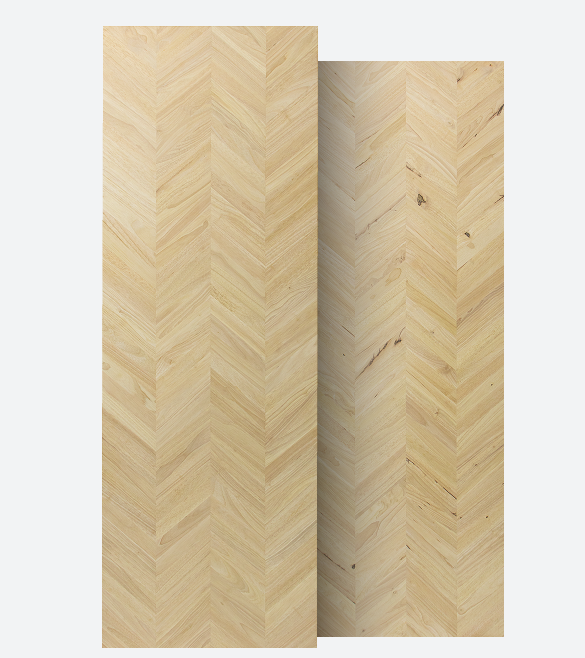
Rubberwood Chevron Countertop
A Desk Top Changes What Consumers Expect From the Surface
Moving Rubberwood from the kitchen into a workspace changes the product conversation.
Consumers choosing a Rubberwood desk top may be less concerned with matching a backsplash or appliances and more interested in whether the surface feels substantial, works with a standing-desk frame and looks appropriate as part of the room.
The lighter appearance of Hevea works well here because it can keep a workspace visually open while still providing the warmth of real wood. Paired with black or white legs, drawers or an adjustable frame, the surface can move from a simple DIY setup into something that feels more like furniture.
This illustrates one of the broader strengths of butcher block. Its identity can shift with the application without requiring the natural material itself to change dramatically.
[IMAGE 5 – DESK TOP]
Suggested image: Rubberwood butcher block desk top on a black standing-desk frame in a bright home office.
Alt: Rubberwood desk top made from light Hevea butcher block
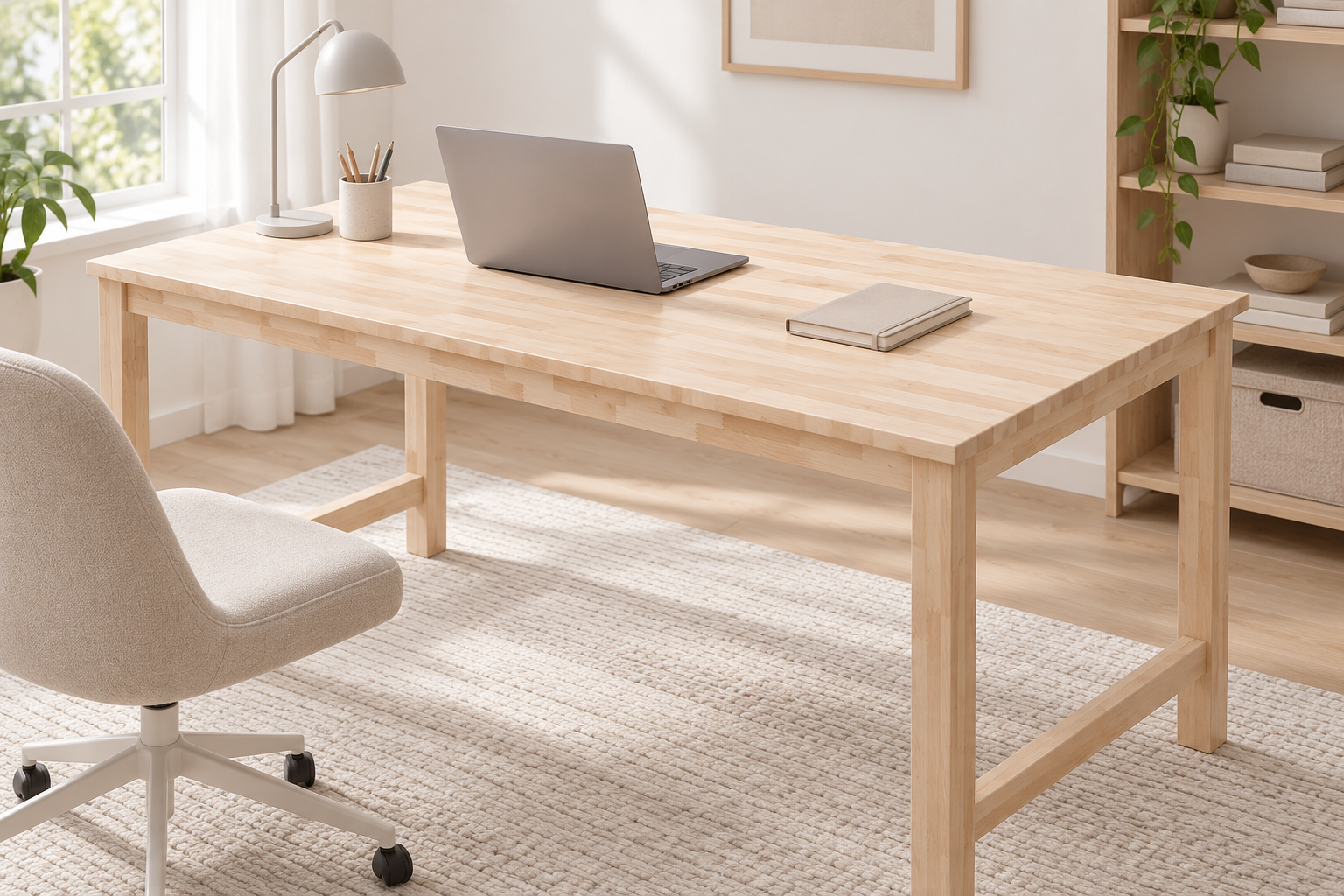
A light Rubberwood butcher block desk brings warmth to a modern home office
Workbench Tops Highlight Practicality Over Decoration
The priorities shift again in a garage or workshop.
A consumer choosing a Rubberwood workbench top may care more about having a substantial work surface, the ability to customize it and the option to refresh the finish later than about matching a carefully designed kitchen.
This is one reason unfinished butcher block can move naturally into workshop applications. The wood remains visually attractive, but it also gives the user freedom to adapt the surface to a more practical environment.
The application demonstrates that natural wood does not have to sit exclusively in decorative categories. The same material can move from a polished residential setting into a working space while retaining its value as a solid wood surface.
Furniture and Utility Surfaces Extend the Same Material Story
Tables, vanity tops, laundry surfaces and other utility applications offer another extension for Hevea wood countertops and butcher block panels.
In a dining area, Rubberwood can provide a lighter table surface that does not visually dominate the room. In a laundry area, it can soften the appearance of cabinets and appliances while providing a practical folding surface. On a vanity or storage unit, natural wood adds warmth to otherwise functional furniture.
These applications work because consumers are increasingly accustomed to seeing similar materials repeated throughout different parts of the home.
A kitchen countertop does not need to match a desk or table exactly, but using related wood tones can make separate spaces feel more connected.
Natural Variation Still Needs to Feel Controlled
Consumers choose wood partly because no two pieces look completely identical, but there is still a limit to how much variation feels comfortable.
When products are viewed online, this becomes particularly important. Consumers build an expectation from photography, product pages and room scenes before the physical surface arrives.
If one Rubberwood Butcher Block panel looks dramatically different from the visual character they selected, natural variation can be interpreted as inconsistency rather than authenticity.
Rubberwood’s relatively balanced color provides a useful starting point, but grading and material selection still matter. The goal is not to remove every natural difference. It is to keep the overall appearance recognizable enough that the consumer still feels they received the product they chose.
Surface Quality Is More Visible Than Manufacturing Technology
Consumers rarely see the processes behind a butcher block panel, but they see the results immediately.
They can notice whether the surface feels smooth, whether adjacent wood pieces align cleanly, whether the edge looks refined and whether the finish appears even. These details influence perceived quality more quickly than most manufacturing specifications ever will.
This is particularly important for lighter Hevea butcher block because clean surfaces can make sanding quality, joints and finishing more visually apparent.
A well-made panel allows the natural grain to be the focus. An inconsistent surface distracts from it.
For retailers and brands, this means manufacturing quality ultimately becomes part of the consumer’s visual experience.
Moisture Stability Becomes Part of Everyday Performance
Moisture control is another issue that begins in manufacturing but ends with the consumer.
Wood naturally responds to changes in humidity. If the material is not properly dried and controlled before becoming a finished surface, dimensional movement may become more noticeable later.
Consumers do not normally describe this as a moisture-management issue. They experience it as a countertop that changes shape, a desk that no longer sits as expected or a panel that develops problems after installation.
For Rubberwood butcher block countertops, proper drying, storage and production control therefore contribute directly to how reliable the product feels in everyday use.
This becomes especially important for large surfaces, where even relatively small dimensional changes can be more noticeable.
Maintenance Needs to Feel Understandable
Natural wood should not require consumers to become wood experts.
One of the factors that can discourage people from choosing butcher block is uncertainty around cleaning, sealing, scratching and long-term maintenance. Clear guidance helps remove that uncertainty.
The exact care routine depends on the finish and application, but consumers should understand what the surface needs before they purchase it. A kitchen worktop may require different consideration from a desk or decorative table surface.
Wood also offers an advantage that is sometimes overlooked: depending on the finish and condition, the surface may be refreshed or refinished rather than immediately replaced.
That ability can become part of the long-term value of choosing a real wood surface.
Packaging Shapes the First Physical Experience
The first time a consumer touches a Rubberwood Butcher Block may be after it has already passed through manufacturing, export packaging, warehousing, distribution and final delivery.
If the product reaches them with a damaged corner or scratched surface, all of the work invested in material selection and finishing becomes much less visible than the damage.
Large wood surfaces require particular attention because their dimensions expose edges and faces to repeated handling. Protection therefore needs to account for how the product will actually move before installation.
Good packaging is not simply a logistics requirement. It protects the first physical impression of the product.
What Consumers Ultimately Want From Rubberwood Butcher Block
The strongest appeal of Rubberwood Butcher Block comes from its ability to balance natural wood character with everyday adaptability.
Consumers get a real wood surface without necessarily introducing strong color contrast into the room. They can select a natural or developed finish, use the product in a kitchen or move it into furniture and workspace applications, and choose between greater customization or greater convenience depending on how the product is finished.
That flexibility is what makes Rubberwood, or Hevea, useful beyond one countertop category.
A good product should therefore answer several consumer expectations at the same time: it should look natural, feel well made, coordinate easily with the surrounding space and perform reliably in the application for which it was chosen.
From Rubberwood Countertop to a Broader Wood Surface Program
The kitchen may be the most familiar starting point, but it does not need to define the limits of Rubberwood Butcher Block.
The same light natural character can move into islands, desks, tables, workbenches, vanities and utility surfaces while still remaining recognizably Hevea. This gives the material a useful position for product programs built around natural wood surfaces rather than one isolated application.
SSR develops Rubberwood and Hevea surfaces with attention to the qualities that remain visible to the consumer: surface appearance, jointing, sanding, moisture control, finishing, consistency and protection through packaging.
Explore Rubberwood Butcher Block with SSR Corporation and discuss how Hevea can support countertops, furniture and other natural wood surface applications.
Frequently Asked Questions
Is Rubberwood the same as Hevea wood?
Yes. Rubberwood comes from Hevea brasiliensis, so Rubberwood, Hevea wood and Heveawood are commonly used to refer to the same material.
What is Rubberwood Butcher Block used for?
Rubberwood Butcher Block can be used for kitchen countertops, kitchen islands, desk tops, table tops, workbench tops, vanity surfaces and other household work surfaces.
What does Hevea butcher block look like?
Hevea generally has a light natural appearance with visible but relatively restrained grain, making it easier to coordinate with different colors and interior materials.
Can Rubberwood butcher block be supplied unfinished?
Yes. An unfinished surface allows the final stain, oil or protective finish to be selected according to the intended appearance and application.
Does Rubberwood take stain well?
FAO research notes that Rubberwood takes stains and finishes well, which contributes to its versatility in furniture and other wood products. FAOHome
Is Rubberwood suitable only for kitchen countertops?
No. The material can also work for islands, furniture, desks, workbenches, tables, vanities and utility surfaces where a natural solid wood surface is desired.